
Getting your videos found on YouTube can feel like a guessing game. With millions of videos uploaded daily, just creating quality content isn't enough to build an audience. The key to rising above the noise is mastering YouTube's search and discovery algorithm. It's not about cheating the system; it's about making it crystal clear to YouTube what your video is about and who it's for, so it can be shown to the right people.
This guide gives you a practical list of YouTube SEO optimization tips designed to boost your channel's visibility. We'll skip the vague advice and focus on specific, actionable strategies that directly impact your rankings, watch time, and subscriber growth. You'll learn not just what to do, but how to do it, with real-world examples you can use right away.
We'll cover everything from the basics of keyword research and optimizing your titles and descriptions to advanced tactics like using transcripts for better indexing and maximizing viewer engagement. Each tip is a piece of the SEO puzzle. By applying these techniques, you can turn your channel into a view-generating machine that consistently attracts your target audience. Let’s dive into the proven methods top creators use to dominate search results and get discovered.
1. Keyword Research and Strategic Placement
The starting point for any successful YouTube SEO optimization strategy is solid keyword research. This means figuring out the exact words and phrases your target audience is typing into the search bar. By strategically placing these keywords in your video's metadata, you give YouTube's algorithm the essential context it needs to understand your content and recommend it to interested viewers. This first step is fundamental to your video's discoverability and organic growth.
How to Implement Strategic Keyword Placement
Think of your video's title, description, and tags as signposts for YouTube's algorithm. For them to be effective, your main keyword needs to appear consistently in a few key places:
- Video Title: Put your most important keyword within the first 60 characters. This makes sure it's fully visible on all devices and immediately tells both viewers and the algorithm what your video is about. For example, instead of "My Review of a New Camera," a better title is "Sony A7IV Review: Is It a Must-Buy in 2024?"
- Video Description: Weave your primary keyword into the first two sentences. YouTube shows this snippet in search results, making it highly valuable real estate.
- Video Tags: Use a mix of 5-8 broad and specific tags. For the camera review, you might use tags like "Sony A7IV," "best hybrid camera 2024," and "Sony A7IV sample footage."
- Video File Name: Before you upload, rename your video file to include your target keyword (e.g.,
sony-a7iv-review-2024.mp4). It’s a small detail, but it provides another SEO signal to YouTube.
Key Insight: The goal isn’t keyword stuffing; it's natural placement. A well-placed keyword in your title and the first line of your description carries more weight than dozens of keywords forced into the text later on.
Furthermore, mentioning keywords in your actual spoken content is a powerful, yet often overlooked, tactic. YouTube automatically transcribes your videos, and when it finds keywords in that transcript, it strengthens your content's relevance. Using a tool for accurate transcription can amplify this effect. You can learn more about the benefits of transcribing your content on meowtxt.com to further optimize your SEO. This technique is a cornerstone of advanced YouTube SEO optimization tips.
2. Video Title Optimization
Your video title is arguably the most important element for YouTube SEO. It’s the first thing people see in search results, on the homepage, and in suggested videos, directly influencing both your click-through rate (CTR) and search ranking. A great title has to do two things at once: include relevant keywords for the algorithm and be compelling enough to make a human want to click.
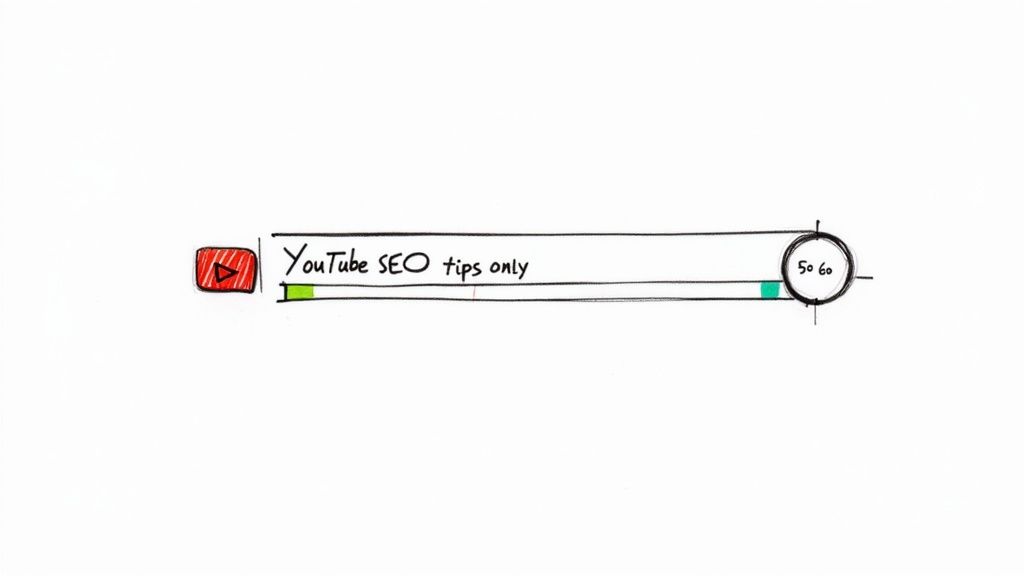
The title is a direct signal to YouTube about your video's content. A strong, clickable title can give you a significant boost in initial viewership, which then encourages the algorithm to recommend your video to even more people. Creators like Ali Abdaal master this with titles like "How I'd Learn to Code (If I Could Start Over)," which combines a keyword ("Learn to Code") with a fascinating human angle.
How to Implement Video Title Optimization
Optimizing your title is a strategic blend of creativity and data. To help your videos rank higher, you can use YouTube video title optimizer tools that help create catchy, SEO-friendly titles. For a manual approach, follow these key steps:
- Lead with Your Keyword: Place your primary keyword within the first 3-5 words. This gives it maximum weight in YouTube’s ranking algorithm and immediately confirms the video's topic for viewers.
- Keep it Under 60 Characters: Titles longer than 60 characters often get cut off in search results, especially on mobile. A concise title ensures your whole message gets across.
- Use Numbers and Power Words: Numbers in titles, like "7 Mistakes to Avoid" or "Best Gadgets in 2024," are proven to increase CTR. Pair them with impactful words like 'Ultimate,' 'Proven,' or 'Complete' to create a sense of authority.
- Balance SEO with Curiosity: While keywords are vital, your title must also be intriguing. Veritasium’s "Why Gravity is NOT What You Think" is a perfect example; it targets a broad topic (gravity) while creating an information gap that makes people want to click.
Key Insight: Your title is a promise to the viewer. It must accurately reflect the content inside. A misleading title might get a click, but if people leave quickly, it will ultimately hurt your video's performance in the algorithm.
3. Comprehensive Video Descriptions
Many creators overlook the video description, but it's an SEO powerhouse. It's your dedicated space to provide rich context, helping YouTube's algorithm deeply understand your video's topic and relevance. A well-written description not only boosts your rankings for your target keywords but also serves as a valuable resource for your viewers, driving engagement and watch time. This is a fundamental part of any list of effective YouTube SEO optimization tips.
How to Implement Comprehensive Video Descriptions
Think of your description as a mini-blog post that supports your video, not just a short summary. A structured, keyword-rich description can make a big difference in discoverability.
- Hook with the First 2-3 Sentences: The first few lines are critical because they appear in search results. Start with your primary keyword and a compelling hook that makes people want to watch. For a video on "budget filmmaking gear," you could start with: "Discover the best budget filmmaking gear that delivers professional results without the high price tag. In this video, we review our top picks for 2024."
- Structure for Readability and SEO: Use paragraphs to organize your text. Aim for a 300-400 word description that naturally includes your primary keyword and related secondary keywords. Add timestamps for key moments to help viewers find what they need and improve the user experience.
- Add Valuable Resources: Link to related playlists, other videos on your channel, and any external resources you mentioned. This encourages viewers to stay on your channel, which boosts your session watch time. Don't forget to add calls-to-action, like asking people to subscribe or join your newsletter.
- Provide Context and Detail: Briefly explain the topics covered in the video. This additional text gives the algorithm more keywords and context to analyze, reinforcing your video's relevance for specific search queries.
Key Insight: A great description serves both the algorithm and the viewer. By optimizing it with keywords for YouTube's crawlers while providing real value and resources for your audience, you create a powerful tool for both discoverability and engagement.
Furthermore, a detailed description works hand-in-hand with your video's spoken content. Just as YouTube analyzes your transcript for keywords, it cross-references that information with the text in your description, confirming your video's topic from multiple angles. You can discover more about the importance of converting video content to text at meowtxt.com to see how these elements can work together.
4. Custom Thumbnails with High Click-Through Rates
While your title and description tell YouTube's algorithm what your video is about, your thumbnail is what convinces a person to click. A well-designed custom thumbnail is like a billboard for your video, and it plays a huge role in your click-through rate (CTR)—a key metric YouTube uses to measure viewer interest. A high CTR tells the algorithm that your content is compelling, which prompts it to show your video to more people. This makes thumbnail design one of the most vital visual YouTube SEO optimization tips.
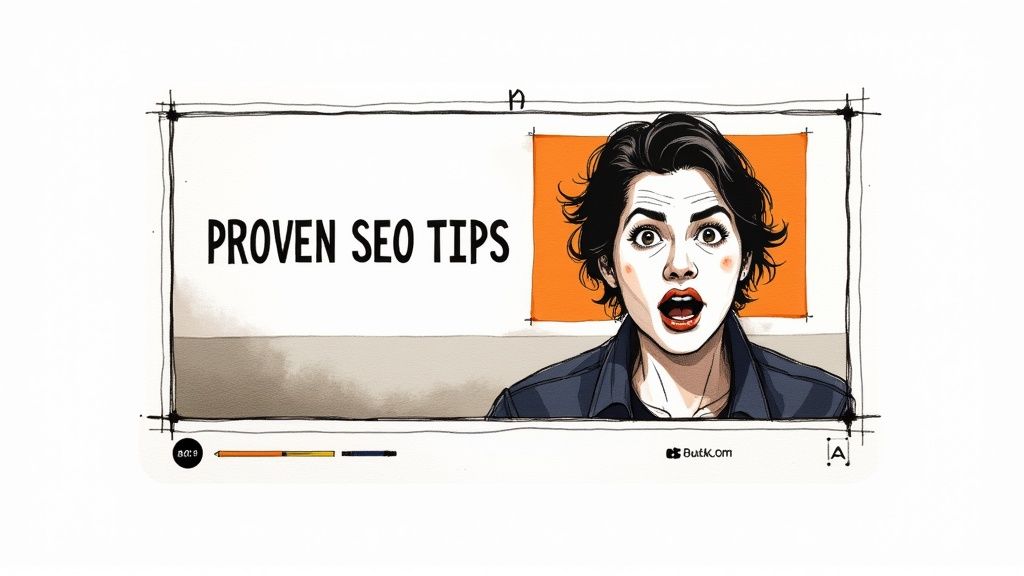
Your thumbnail should visually summarize your video's promise, spark curiosity, and set expectations. It has to stand out in a crowded feed of search results and suggested videos. Creators like MrBeast are masters of this, using bold colors, expressive faces, and minimal text to create an irresistible urge to click, which directly boosts their videos' performance.
How to Implement High-CTR Thumbnails
Creating a thumbnail that gets clicks requires a strategic approach that blends art and data. The goal is to be instantly understandable and visually appealing, even on a tiny mobile screen.
- Clarity and Simplicity: Use a high-quality, clear image that accurately represents your video. Focus on a single subject, often a person's face showing a strong emotion like surprise or excitement, as this naturally draws the human eye.
- Minimal, Bold Text: If you use text, limit it to 3-5 large, easy-to-read words. The text should add to the visual, not just repeat the title. Use high-contrast colors to make the words pop against the background.
- Consistent Branding: Develop a consistent visual style for your thumbnails. Creators like Linus Tech Tips use a similar layout, font, and branding across their thumbnails, making their content instantly recognizable to their subscribers.
- Analyze the Competition: Before you finalize your design, search for your target keyword on YouTube. Look at the top-ranking thumbnails and find a way to stand out with a different color scheme, composition, or emotional appeal.
Key Insight: Your thumbnail and title should work together as a one-two punch. The thumbnail grabs attention with a powerful visual, and the title provides the context that secures the click. They should complement each other, not repeat the same information.
5. Strategic Tag Implementation
While they don't carry as much weight as your title or description, video tags are still an important part of your metadata. Think of them as supplemental keywords that provide extra context about your video's content, niche, and category. Using tags effectively helps YouTube understand the nuances of your video and connect it with a wider, more relevant audience, especially for long-tail search queries. This practice is a key part of any complete YouTube SEO optimization strategy.
How to Implement Strategic Tagging
Structuring your tags properly helps the algorithm categorize and recommend your content. For the best results, your tags should be a mix of broad and specific terms that accurately describe your video's topic.
- Prioritize Your Keywords: Your very first tag should always be your main target keyword. This reinforces the topic you established in your title and description. For a video about making sourdough bread, the first tag should be "sourdough bread recipe."
- Mix Broad and Specific Tags: Combine general category tags (like "baking" or "how-to") with more specific, long-tail tags (like "beginner sourdough starter" or "no-knead sourdough bread method"). This helps you capture a wider range of searches.
- Include Variations and Synonyms: Think about different ways people might search for your topic. Use variations like "sourdough for beginners" and "easy sourdough recipe" to cover all your bases.
- Use Tools for Research: Look at top-performing videos in your niche to see what tags they're using. For better visibility, you can also research and include popular YouTube hashtags that are relevant to your content to expand your reach.
Key Insight: The best tagging strategy is to think like a viewer. What words and phrases would they type into the search bar to find your video? Your tags should mirror that language. Avoid using misleading or irrelevant tags, as this can hurt your video's performance.
6. Engagement and Watch Time Optimization
Beyond keywords and metadata, YouTube’s algorithm heavily favors videos that keep people on the platform longer. Optimizing for engagement signals (likes, comments, shares) and Watch Time is essential because these metrics tell YouTube that your content has value. A high audience retention rate signals that your video is satisfying viewers, which prompts the algorithm to promote it more widely in search results, suggested videos, and on the homepage. This makes retention a critical part of all effective YouTube SEO optimization tips.
How to Implement Engagement and Watch Time Optimization
The key is to create a compelling viewing experience that holds people's attention from the first second to the last. This involves both how you structure your content and how you encourage your audience to participate.
- Hook Viewers Immediately: The first 15-30 seconds are make-or-break. Start with a bold statement, an interesting question, or a preview of the most exciting part of the video. This prevents viewers from clicking away and gives your audience retention a strong start.
- Maintain Pacing: Use pattern interrupts like changing camera angles, adding B-roll, using on-screen text, or shifting your tone to keep things interesting. Channels like Kurzgesagt use fast-paced animation and narration to keep their average view duration extremely high.
- Encourage Interaction: Don't just ask people to "like and subscribe." Ask a specific question related to the video's content to start a real conversation in the comments. Responding to comments promptly also boosts this engagement signal.
- Use End Screens and Cards: Strategically place cards during your video to link to related content or playlists. Use your end screen to recommend another one of your videos, encouraging viewers to keep watching and increasing your overall session watch time.
Key Insight: Watch Time is a measure of value. The longer someone watches your video, the more valuable YouTube considers it to be. Focus on crafting a story that pulls viewers all the way through, rather than just optimizing the first few seconds.
7. Playlist Creation and Organization
Creating and organizing playlists is a powerful, but often overlooked, strategy for boosting your channel’s performance. When you group related videos together, you create a cohesive experience that encourages binge-watching. This significantly increases session watch time—a critical metric that tells YouTube's algorithm that your channel provides high-value, engaging content. Well-organized playlists keep viewers on your channel longer, which can improve the rankings of all the videos within that playlist.
How to Implement Strategic Playlist Organization
Think of playlists as curated content series that guide your audience through your videos. This structure not only improves the user experience but also adds another layer of keyword-rich metadata for YouTube to index, making it a key part of any list of YouTube SEO optimization tips.
- Create Thematic Playlists: Group videos around core topics, keyword themes, or content series. For instance, a channel like FreeCodeCamp organizes videos into playlists like "Python for Beginners" or "Full JavaScript Course," creating logical learning paths.
- Optimize Playlist Metadata: Just like individual videos, playlists have titles and descriptions that you should optimize. Use your target keywords in the playlist title and write a detailed description explaining what the series is about.
- Order Videos Logically: Arrange the videos in a sequence that makes sense, such as starting with introductory concepts and moving to more advanced topics. This encourages viewers to click "Play All" and watch them in order. Aim for at least 5-10 videos per playlist to make them substantial.
- Promote Your Playlists: Feature your key playlists on your channel's homepage. You can also use end screens and cards in your videos to direct viewers to a relevant playlist, keeping them within your content ecosystem.
Key Insight: A playlist acts as a force multiplier for your watch time. When a viewer watches several videos from a playlist in one sitting, YouTube's algorithm sees your channel as a source of satisfying, long-form content, which can boost your overall discoverability.
Furthermore, adding new content to your playlists keeps them fresh and signals to YouTube that your channel is active. Creating a "Start Here" playlist for new subscribers is a great way to introduce them to your best content and immediately increase their session duration. This strategic organization helps turn casual viewers into engaged subscribers by providing a structured and valuable content journey.
8. Captions, Transcripts, and Closed Captioning
Beyond making your content accessible, accurate captions and transcripts provide a powerful, text-based layer of data for YouTube's algorithm. While YouTube automatically generates captions, they are often full of errors. By manually editing them or providing a professional transcript, you allow the algorithm to precisely index every single word spoken in your video. This dramatically improves its ability to rank your content for long-tail keywords and specific search queries. This is one of the most underused but effective YouTube SEO optimization tips.
How to Implement Captions and Transcripts for SEO
Think of your spoken words as a hidden treasure of keywords. Accurate captions unlock this potential by providing a full script for YouTube to analyze. Proper implementation ensures you get the maximum SEO benefit.
- Edit Auto-Generated Captions: Always start by downloading YouTube's auto-generated caption file (.SRT). Go through it line by line to fix spelling, grammar, and punctuation. Pay close attention to brand names, technical terms, or names that the AI is likely to get wrong.
- Insert Keywords Naturally: As you edit, make sure your target keywords and related phrases are transcribed correctly. The algorithm cross-references the spoken words in your captions with the keywords in your title, description, and tags, creating a very strong signal of relevance.
- Translate for Global Reach: Expand your audience by translating your accurate English captions into other languages. This helps your video show up in search results for viewers in different parts of the world, massively increasing your potential reach.
- Ensure Proper Timing: Make sure the captions are perfectly synced with the audio. Poorly timed captions create a bad user experience, which can negatively affect your watch time and viewer retention signals.
Key Insight: A manually corrected transcript isn't just an accessibility feature; it's a detailed sitemap of your video's content for search engines. Every corrected word strengthens YouTube's understanding of your video's topic and its relevance to viewer searches.
Implementing high-quality captions can directly boost key metrics like watch time, as many people watch videos with the sound off. Channels like TED Talks excel at this, providing meticulously accurate and translated captions that enhance both user experience and discoverability. You can learn more about how to add captions to your YouTube videos on meowtxt.com to ensure you're maximizing this SEO advantage.
9. Consistency and Content Calendar Strategy
One of the most powerful signals you can send to YouTube's algorithm is reliability. A consistent publishing schedule does more than just keep your subscribers engaged; it builds algorithmic momentum. YouTube’s system favors active channels that regularly provide value, increasing the chance that your new videos will be promoted across the platform. This consistent output helps establish your channel as a dependable authority in your niche, a key factor in long-term growth and one of the most fundamental YouTube SEO optimization tips.
How to Implement a Content Calendar Strategy
A content calendar is your roadmap to consistency, turning a sporadic hobby into a strategic operation. This tool helps you plan, schedule, and execute your content without the last-minute stress, ensuring a steady stream of high-quality videos that meet your audience's expectations.
- Choose a Sustainable Schedule: Don't commit to a daily schedule if you can only realistically produce one high-quality video per week. Consistency is more important than frequency. Channels like Linus Tech Tips maintain a multi-weekly schedule that their audience has come to expect.
- Communicate Your Schedule: Announce your upload days and times in your channel banner, video outros, and community posts. This sets expectations and trains your audience to come back for new content.
- Build a Content Buffer: Aim to have 2-4 weeks of videos filmed, edited, and ready to upload. This buffer prevents burnout and ensures you never miss an upload day due to unexpected delays.
- Plan Ahead: Use your calendar to map out content series, seasonal videos, and responses to potential trends. This foresight allows you to align your content with timely search interest.
- Use YouTube's Scheduler: Upload your finished videos in advance and use YouTube Studio's built-in scheduling feature to publish them at the best time for your target audience's time zone.
Key Insight: Consistency isn't just about how often you upload; it's about creating a predictable viewing habit. When viewers know when to expect your next video, they're more likely to watch it soon after it's released, sending strong positive signals to the algorithm.
10. Community Building and Audience Interaction
Beyond your video's metadata, YouTube's algorithm increasingly rewards channels that cultivate an active, engaged community. Fostering audience interaction through comments, live streams, and community posts sends powerful signals to YouTube that your content is valuable and resonates with viewers. An engaged community not only boosts watch time and session duration but also tells the algorithm directly that your videos are worth promoting to a wider audience.
How to Implement Community-Building Strategies
Building a community is an ongoing process that turns passive viewers into loyal fans. Integrating interaction into your content strategy is a critical part of modern YouTube SEO optimization tips. Here are several actionable methods:
- Engage with Comments: Make it a priority to reply to top comments within the first 24 hours of posting a video. Pinning a thoughtful comment that adds value or sparks discussion can also keep the conversation going long after the initial upload.
- Utilize Community Posts: Use the Community Tab to interact with your audience between uploads. Post polls, ask questions, or share behind-the-scenes content to maintain channel momentum. Creators like MrBeast use this feature to build hype for upcoming videos.
- Host Live Streams: Schedule regular live streams or Q&A sessions to interact with your audience in real-time. This direct engagement fosters a strong connection and generates significant watch time, a crucial ranking factor.
- Prompt Interaction: End your videos with a clear, open-ended question that encourages viewers to share their own experiences or opinions in the comments. This simple call-to-action can dramatically increase your video's engagement rate.
Key Insight: YouTube's algorithm doesn't just measure what people watch; it measures how they interact. A video with 100 comments and active replies is often seen as more valuable than a video with 1,000 views and no interaction, signaling a higher quality of engagement.
Furthermore, actively managing your community shows that you value your audience. Showing appreciation for loyal members and moderating comments to keep things positive encourages repeat viewership and strengthens your channel's authority. This holistic approach to engagement is a cornerstone of a sustainable and effective YouTube SEO strategy.
YouTube SEO: 10-Point Strategy Comparison
| Strategy | 🔄 Implementation Complexity | ⚡ Resource Requirements | 📊 Expected Outcomes | 💡 Ideal Use Cases | ⭐ Key Advantages |
|---|---|---|---|---|---|
| Keyword Research and Strategic Placement | Medium — ongoing research and updates | Moderate — SEO tools + time (TubeBuddy, Ahrefs) | 📊 ⭐⭐⭐⭐ — improved discoverability, targeted organic traffic | New or growing channels focused on organic search and niche targeting | ⭐ Cost-effective, scalable visibility and higher CTR |
| Video Title Optimization | Low–Medium — copywriting and testing | Low — time for crafting + A/B testing tools | 📊 ⭐⭐⭐⭐ — significant CTR lift and ranking influence | Launches, trending topics, videos that rely on impressions | ⭐ High immediate impact on CTR and search performance |
| Comprehensive Video Descriptions | Medium — structured long-form content | Moderate — writing time, link curation | 📊 ⭐⭐⭐ — better SEO, more context, increased watch time | Tutorials, resource-heavy videos, long-form content | ⭐ Improves context, external traffic, and discoverability |
| Custom Thumbnails with High Click-Through Rates | Medium — design + iterative testing | Moderate–High — design skills or outsourced costs | 📊 ⭐⭐⭐⭐ — notable CTR increase and stronger branding | Competitive niches and attention-driven content | ⭐ Big ROI on views; strengthens brand recognition |
| Strategic Tag Implementation | Low — select and prioritize tags | Low — minimal time, research for tags | 📊 ⭐⭐ — modest categorization benefits and long-tail reach | Complementary SEO step for niche/long-tail topics | ⭐ Quick to implement; supports relevance signals |
| Engagement and Watch Time Optimization | High — content quality and retention tactics | High — production effort, community management | 📊 ⭐⭐⭐⭐ — major boost in recommendations and ranking | Channels prioritizing retention, storytelling, education | ⭐ Core ranking driver; builds loyal audience and authority |
| Playlist Creation and Organization | Low–Medium — thematic planning and ordering | Low — organizational time to assemble playlists | 📊 ⭐⭐⭐ — increases session duration and surfaces older videos | Course-style content, series, topic deep-dives | ⭐ Boosts cumulative watch time and content discovery |
| Captions, Transcripts, and Closed Captioning | Medium — accurate transcription and review | Moderate — time or paid transcription/translation services | 📊 ⭐⭐⭐ — improved accessibility, watch time, and SEO | International audiences, accessibility-focused channels | ⭐ Enhances reach via searchable text and accessibility compliance |
| Consistency and Content Calendar Strategy | Medium–High — scheduling discipline and planning | Moderate–High — sustained production resources | 📊 ⭐⭐⭐ — steady audience growth and algorithm favorability | Channels aiming for growth, episodic or serialized content | ⭐ Builds viewer habits and improves long-term performance |
| Community Building and Audience Interaction | High — active moderation and engagement | High — time for replies, live events, and moderation | 📊 ⭐⭐⭐ — stronger retention, social proof, repeat views | Creators seeking loyal audiences and community monetization | ⭐ Increases engagement signals, feedback, and retention |
From Tips to Triumph: Your Next Steps in YouTube SEO
You’ve just worked through a complete roadmap of actionable YouTube SEO optimization tips, going far beyond the generic advice you see elsewhere. We've broken down the key parts of the YouTube algorithm, from the initial hook of a keyword-rich title and a high-contrast thumbnail to the sustained engagement driven by watch time and community interaction. This guide wasn't just about listing what to do; it was about explaining why each element is important and how to implement it for real results.
The path to YouTube success isn't a sprint fueled by one viral video. It's a marathon built on consistent, smart optimization. The real power of these tips lies in how they connect. A great title is amplified by a compelling thumbnail. A detailed description gives context to your tags. High watch time tells the algorithm that your content, supported by accurate captions, delivers on its promise. Each tip is a gear in a larger machine, and when they work together, they create unstoppable momentum for your channel.
Synthesizing Strategy into Action
All this information can feel overwhelming, but the path forward is simpler than it seems. Don't try to implement every single one of these YouTube SEO optimization tips at once. Instead, take a layered, step-by-step approach. Think of it like building a house: you lay the foundation before you put up the walls.
Your immediate next steps should focus on the foundational "on-page" SEO elements that provide the biggest initial impact. Here's a practical, prioritized action plan for your next video upload:
- Start with Keywords: Before you even press record, spend time on solid keyword research. Identify a primary keyword and 2-3 related secondary keywords. This one step will inform everything else you do.
- Craft Your Metadata Trio:
- Title: Write a title that is both appealing to humans (clickable, intriguing) and optimized for bots (includes your primary keyword at the front).
- Description: Draft a comprehensive description (at least 250 words) that naturally includes your keywords, adds timestamps, and links to relevant resources.
- Thumbnail: Design a custom thumbnail that stands out in a sea of search results. Use bold text, clear imagery, and contrasting colors to stop the scroll.
- Focus on the First 30 Seconds: Script a powerful hook that grabs attention right away. Your goal is to signal to viewers and the algorithm that your video delivers value from the very start, which is critical for boosting watch time.
Once you master this foundational workflow, you can begin layering in more advanced strategies. Start organizing your existing videos into keyword-themed playlists. Make a real effort to respond to comments within the first 24 hours to build your community. Most importantly, start using your captions and transcripts not just for accessibility, but as a powerful, searchable asset for your content.
This systematic approach turns abstract knowledge into real results. You're no longer just uploading videos; you're strategically publishing assets designed to be found. Mastering these YouTube SEO optimization tips is your key to unlocking sustained channel growth, reaching a wider audience, and building a powerful brand on the world's second-largest search engine. Your journey from creator to authority starts now.
Ready to supercharge your content's discoverability? Accurate transcripts and captions are a cornerstone of advanced YouTube SEO, and meowtxt makes it effortless. Visit meowtxt to see how our fast, precise transcription service can help you generate searchable video text, create SRT files for captions, and unlock new audiences for your channel.


