
Trying to translate German to English audio on a deadline often feels impossible. You're usually stuck between slow, pricey freelancers and clunky software that delivers a garbled, unusable translation. Neither option gets the job done right, leaving you with wasted time and a wrecked budget.
Why Traditional German Audio Translation Misses the Mark
Before we dive into the solution, let’s talk about why the old methods are so frustrating. If you've ever needed to get a German recording into English, these issues will sound painfully familiar. They’re the bottlenecks that kill project momentum and drain your resources.
Imagine a marketing team needing to repurpose a German webinar for a UK audience. They hire a translator, but the turnaround time is a week or more, and the invoice quickly climbs into the thousands. The final text might be accurate, but it’s far from efficient.
The Headaches of Manual Translation
Going the traditional route is filled with challenges that go beyond just time and money. You’re typically battling:
- Long Turnaround Times: Manual translation is a meticulous, hands-on process. A single one-hour audio file can easily take a professional translator several days to transcribe and then accurately translate.
- High Costs: Quality freelancers charge premium rates, often billed per minute or per word. This makes translating large batches of audio financially impractical for many teams.
- Inconsistent Quality: The final transcript can be a gamble. Its quality depends entirely on the freelancer's skill, their familiarity with your industry jargon, and frankly, how focused they were.
This isn't just a minor annoyance; it's a massive barrier. In a world that thrives on instant content, these delays mean you're missing out on real opportunities.
The real issue with old-school translation is its inability to scale. It forces you to pick two out of three: speed, cost, or quality. You almost never get all three.
When Clunky Software Fails
The first generation of translation software wasn't much better. These tools were notorious for mangling idioms, failing on technical terms, and being unable to distinguish between different speakers.
A common German phrase like "Ich verstehe nur Bahnhof" would get a painfully literal translation such as, "I only understand train station," leaving your English-speaking audience utterly confused.
This unreliability makes older tools useless for professional work. For corporate training materials, podcasts, or academic lectures, they simply aren’t good enough.
It’s no surprise that the demand for better solutions is driving massive growth in language technology. The German language translation software market is already valued at around USD 5.4 billion and is projected to hit USD 9.7 billion by 2035. This is largely because Germany is Europe’s biggest market for these tools, with businesses desperately seeking AI-driven platforms to handle audio and speech translation. You can explore these market trends and projections for translation software.
This growth highlights a fundamental shift. A modern, AI-powered approach is no longer a luxury—it’s a necessity for anyone who needs to translate German audio to English with both speed and accuracy.
Preparing Your German Audio for a Flawless Translation
The secret to an excellent AI translation isn't just the software—it's the quality of the audio you provide. If you want to translate German to English audio with precision, taking file preparation seriously is the best thing you can do. It's like laying a clean foundation for a house; the better the audio, the more intelligently the AI performs.
This is more than just generic advice. It’s about the small details that make a huge difference in the final transcript. For instance, the audio format you choose is critical. While MP3s are popular for their small size, a lossless format like WAV gives the AI much more data to work with, leading to a more accurate transcription from the very beginning.
Clean Up Your Audio for the Best Results
Even the clearest recordings can have distracting background noise. Things like fans, air conditioners, or distant traffic can sneak in and create artifacts that trip up translation algorithms.
I learned this the hard way on a project where a faint air conditioner hum nearly derailed everything. The AI kept misinterpreting the low-frequency noise, spitting out dozens of transcription errors that took hours to fix manually. A simple audio cleanup session beforehand would have saved me an entire afternoon.
Luckily, you don’t need a fancy studio to solve this. Free tools like Audacity have powerful noise reduction features that can isolate and remove these sounds in just a few clicks. It’s a five-minute step that can dramatically improve your final output.
Pre-upload audio cleanup is non-negotiable. Skipping it is like asking a professional artist to paint on a dirty canvas—the final result will always show the flaws of the original surface.
Your Pre-Upload Checklist
Before you upload your German audio, run through this quick checklist. Each point is designed to prevent the common issues that can stump even the most advanced AI.
- Check Your Recording Levels: Aim for audio that peaks between -6dB and -12dB. If it’s too quiet, the AI will struggle to hear the words clearly. Too loud, and you’ll get clipping and distortion that garbles the sound.
- Separate Your Speakers: If you’re working with an interview or podcast, try to have each speaker on a separate audio track. This helps the AI identify who is speaking much more accurately and prevents overlapping dialogue from becoming a mess.
- Pick the Right File Format: As mentioned, WAV is your best bet for quality. If you must use a compressed format, go for a high-bitrate MP3 (at least 192kbps). For more on file types, our article on how to convert MP4 to MP3 format can be helpful.
For a deeper dive into recording techniques and gear, checking out a professional voice-over guide can also provide some excellent tips. Taking these steps ensures your file is primed and ready for a perfect translation.
Getting Your German Audio Translated with MeowTXT
Alright, you’ve prepped your file and your German audio is crisp and clean. Now for the easy part. Let's walk through exactly how to translate German to English audio using MeowTXT. This isn't a technical manual; it's a simple tour to get you from a raw audio file to a polished English transcript in record time.
To make this practical, let’s imagine we’re converting a German business webinar into an English blog post. This is a perfect example of how you can repurpose a single piece of content for a global audience with just a few clicks. The goal is to make every step so clear that you get it right on the first try.
From Upload to Instant Transcription
Your journey starts at the MeowTXT dashboard. The entire interface is built for speed—you can drag and drop your prepared audio file directly into the upload area. No navigating through confusing menus. It’s designed to be that simple.
Once your file is in, the platform immediately gets to work. But before it can translate, it first has to transcribe the original German speech into text. This is where your earlier audio cleanup really pays off. A clean file results in a much more accurate initial transcription, and that text is the foundation for a great translation.
Dialing in Your Translation Settings
This is the most crucial part of the process—telling the AI exactly what you need. After your German audio is uploaded, you’ll see a few simple but powerful options that will define the final output.
- Source Language: First, you have to tell the system the audio is in German. It sounds obvious, but it's a common mistake. Setting the wrong source language is a fast track to nonsensical results. The AI needs to know what it's listening for.
- Target Language: Next, select English as your desired output language. MeowTXT handles over 100 languages, so being specific here is key.
- AI Model Selection: You might also see options for different AI models. For our business webinar example, a model trained on formal or technical language would be the best fit. If you were translating a casual podcast, you’d likely choose a more conversational model. This choice helps fine-tune the AI’s understanding of context and nuance.
This flowchart illustrates the simple, yet vital, path of preparing your audio to achieve the best possible translation.
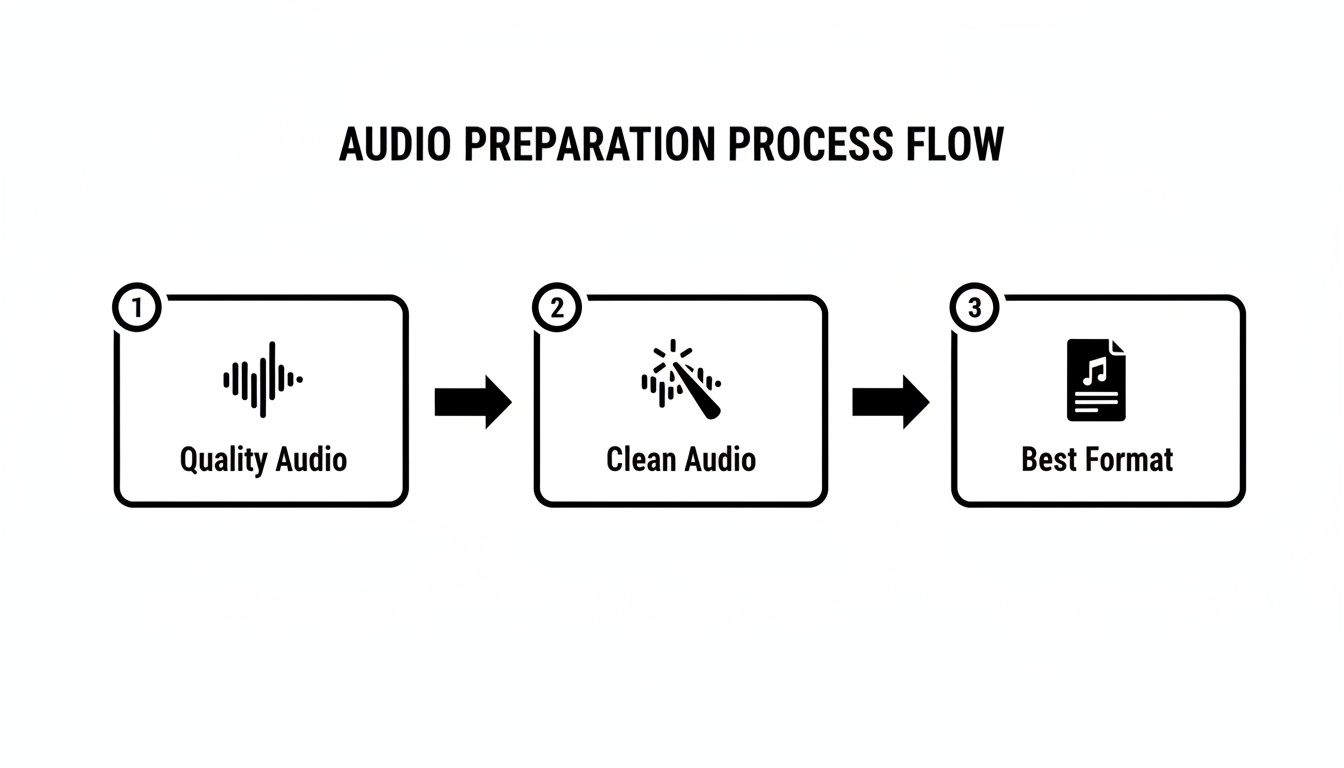
As the visual shows, a high-quality, clean, and properly formatted audio file isn't just a nice-to-have; it's the essential starting point for any successful AI-powered German to English audio translation.
With your settings locked in, just hit "Transcribe & Translate" and let the platform work its magic. Thanks to powerful AI, what used to take a human translator days can now be done in minutes. An hour-long webinar? Fully transcribed and translated before you finish your coffee. For more general tips, our guide on how to translate audio to English has some great extra insights.
The real power of a tool like MeowTXT isn't just the translation itself; it's the speed at which it delivers a highly accurate first draft. This lets you shift your focus from waiting to refining.
The AI is surprisingly good at handling complex German sentences and industry-specific jargon, which is vital for our business webinar scenario. The text you get back isn't a clunky, word-for-word translation. It’s a coherent and readable English text that captures the original meaning, setting you up perfectly for the final editing phase.
How to Review and Refine Your AI-Generated Translation
The AI has done the heavy lifting and gotten you about 95% of the way there. That's the easy part. But that last 5%? That’s where your human touch comes in. This crucial step turns a technically correct translation into one that feels natural and ready for your audience.
Most modern tools, like MeowTXT, provide an interactive editor where you can see the original German transcription next to the English translation. This side-by-side view is your best friend for spotting subtle mistakes and awkward phrasing that even the best AI models can miss.
Spotting Common AI Translation Quirks
When you start your review, you're not just looking for typos. You're hunting for specific error patterns that often appear when you translate German to English audio. The goal is to make the final text read as if a native English speaker wrote it from scratch.
Over the years, I've developed a mental checklist for this process. Here’s what I always look for first:
- Literal Idiom Translations: German is filled with colorful idioms that don't work when translated word-for-word. An AI might take "Ich verstehe nur Bahnhof" and produce the baffling "I only understand train station." You'll need to step in and change it to the English equivalent, like "It's all Greek to me."
- Misattributed Speakers: In conversations with rapid back-and-forth, AI can sometimes get confused and assign a line of dialogue to the wrong person. The side-by-side editor makes this a simple fix—just play the audio snippet for that line and reassign the speaker.
- Unnatural Phrasing: This is the most common issue. The grammar might be technically perfect, but a sentence just feels clunky or stiff. This is where your intuition is key. Your job is to smooth out the language so it captures the speaker's original intent and tone.
Think of the review process as a collaboration, not a correction. The AI provides speed and a solid foundation; you provide the nuance, cultural context, and final polish.
A Quick Guide to Polishing Your Text
To make your review more efficient, try working in passes instead of just reading from top to bottom. For example, do one pass just for idioms, another for speaker labels, and a final one for flow and tone. Even with tools like Auralume AI constantly improving model performance, the human eye remains the ultimate quality check.
Here’s a quick-reference table showing some common AI translation hiccups and how to think about fixing them.
Common AI Translation Errors And How To Fix Them
When you translate German audio to English text, AI can sometimes stumble over cultural nuances, idioms, and complex sentence structures. This table highlights typical mistakes and shows the correct, natural-sounding English equivalent.
| Error Type | German Example (Literal AI Translation) | Correct English Meaning |
|---|---|---|
| Idiomatic Errors | "Er hat nicht alle Tassen im Schrank." (He doesn't have all the cups in the cupboard.) | "He has a screw loose." or "He's not all there." |
| Formal vs. Informal | Using "Sie" translated as "you" in a friendly, casual conversation. | Adjust to more informal phrasing, depending on the relationship between speakers. |
| Compound Nouns | "Donaudampfschifffahrtsgesellschaftskapitän" | "Danube steamship company captain" (often needs context to simplify). |
These examples show that a direct, literal translation often misses the point. Taking the time to adjust these small but significant details is what makes the final output truly professional.
This final polishing phase is incredibly important. To dive deeper into best practices for ensuring accuracy, you can learn more about the essentials of proofreading in transcription in our detailed guide.
By actively hunting for these common AI quirks, you'll quickly refine the machine-generated draft. The goal isn't just to ensure the English version says the right thing, but that it feels right, capturing the spirit of the original German audio and connecting with your new audience.
Putting Your Translated English Content to Work
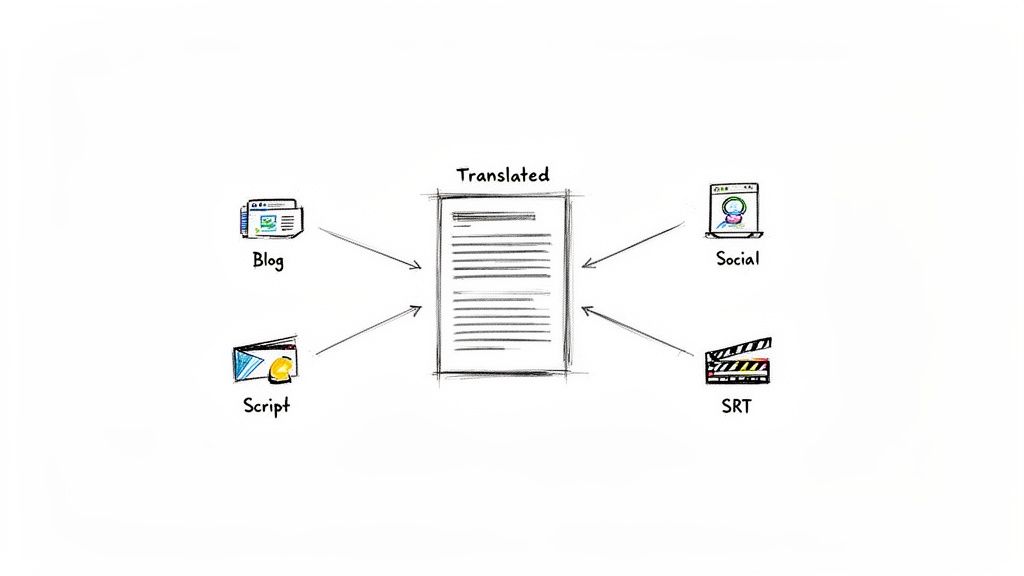
You have your polished English translation. So, what’s next? Getting the text is just the beginning. The real magic happens when you turn that single piece of content into an engine for reaching a completely new audience. This is where your effort to translate German to English audio truly pays off.
The first step is exporting your work, and the format you choose depends on your end goal. A tool like MeowTXT offers several export options, each leading to a specific destination.
Choosing the Right Export Format
Making the right choice here saves you a lot of headaches later. It’s all about matching the file type to the job.
- Plain Text (.txt): This is your versatile, all-purpose format. It’s perfect for quickly pasting the text into a CMS for a blog post or drafting social media updates. No fuss, no strange formatting.
- Word Document (.docx): Choose this format when you need to collaborate with your team for edits, comments, or a final review. It maintains a clean structure and is the universal language for teamwork.
- Subtitle File (.srt): This one is essential for video. An SRT file contains not just the text but also the precise timestamps needed for captions on YouTube, Vimeo, or your own website.
For the webinar we translated earlier, I would probably export all three. This gives us the raw materials for a complete content strategy, all from one original audio file.
The goal is to maximize your return on effort. By strategically exporting your translation in different formats, you lay the groundwork to repurpose one piece of German audio into an entire library of English content.
From a Single Translation to a Multi-Channel Strategy
With your new files ready, the real fun begins. That single translated webinar script is now a goldmine of content waiting to be repurposed.
Think about it. You can take the key insights from the text and create a detailed blog post. Then, pull out the most impactful quotes and stats to fuel a week’s worth of social media clips for LinkedIn or Instagram.
You could even use the .docx file as a clean script for an English-speaking voiceover artist. Just like that, you've produced a fully localized version of your original webinar, making it feel native to a new market. The growth in this space is undeniable; audio translation tech is part of a market expected to grow by USD 217.2 million by 2028. That momentum is what's driving better, faster tools for everyone. You can read more about the speech-to-speech translation market trends and forecasts.
This is no longer just about translation. It's about transforming one piece of German audio into a multi-faceted campaign that dramatically expands your reach and connects you with a global audience.
Got Questions About Translating German Audio?
When you first start using automated audio translation, it's normal to have questions. The details can seem tricky, but once you understand what today's AI tools can (and can't) do, you'll manage your projects with much more confidence. Let's tackle some of the most common questions people ask when they need to translate German to English audio.
Right away, people often wonder how well an AI can truly understand German. The short answer? Surprisingly well. Modern platforms don't just perform clunky word-for-word swaps; they are built to grasp context, which makes a world of difference in the final output.
How Accurate Is AI for Translating German Audio to English?
This is the big one. With clear, high-quality audio, modern AI tools can achieve over 95% accuracy. They excel with formal and technical language but might occasionally stumble on deep cultural idioms or sarcasm.
That’s precisely why the final human review we discussed earlier is so vital. It’s not about rewriting everything; it’s about perfecting the tone and catching those last few nuanced errors. You get a solid draft to start with, saving you a huge amount of time.
Can I Translate Audio with Multiple Speakers?
Yes, absolutely. This is a massive leap forward. Advanced platforms use a feature called speaker diarization to automatically detect and label different voices (e.g., 'Speaker 1,' 'Speaker 2').
This is a lifesaver for translating interviews, podcasts, or meetings. It clearly attributes who said what in both the original German transcript and the final English translation, so you don't have to spend hours untangling a messy conversation. It keeps the flow of the original dialogue perfectly intact.
The ability to distinguish between speakers is one of the biggest game-changers in audio AI. It moves beyond simple transcription to capturing the interactive nature of a conversation, which is critical for an accurate translation.
What Is the Best Audio Format for Translation?
For the best possible accuracy, you'll want to use lossless formats like WAV or FLAC. They provide the AI with the most audio data to analyze, which means fewer mistakes.
However, a high-bitrate MP3 (like 320kbps) is also an excellent choice and offers a much smaller file size. The main thing to avoid is heavily compressed, low-quality audio, which can introduce artifacts and confuse the AI.
How Long Does It Take to Translate an Hour of Audio?
This is where AI truly shines. An hour-long German audio file can typically be transcribed and translated in just a few minutes—often under 10.
Compare that to the days it might take for manual translation, and you can see why this is such a game-changer. The bulk of your time will be spent on that quick final proofread, not waiting for the machine to finish.
Ready to see this speed and accuracy for yourself? With MeowTXT, you can translate your German audio to English in minutes. Stop waiting and start creating. Try it now at MeowTXT.


