
When you need to translate German audio to English, you're looking for more than a simple word-for-word swap. The best methods and tools blend speed with precision, ensuring the final text doesn't just say the same thing, but means the same thing, perfectly capturing the original tone and context.
Why Precise German Audio Translation is Essential
Before diving into the "how," let's touch on the "why." Translating audio from German to English is about closing communication gaps where every detail matters. One small misinterpretation can twist the meaning of a sentence, leading to anything from minor confusion to costly mistakes.
Imagine a business deal being finalized in German. A single mistranslated term could alter a contract, creating legal risks. Or consider a student learning from a translated lecture—if a key concept is off, it undermines their understanding. For content creators, a poor translation can kill the intended humor or emotion, alienating the audience you're trying to reach.
The Real-World Impact of High-Quality Translation
Getting the translation right builds trust and opens doors. When you accurately translate German audio to English, you preserve the speaker's original intent. This precision is vital across many fields:
- International Business: Ensuring everyone in a virtual meeting is on the same page about agreements and next steps.
- Academic Research: Providing researchers with accurate English transcripts of German interviews, historical recordings, or lectures.
- Media and Entertainment: Creating subtitles or dubs for podcasts, films, and videos that feel natural and authentic to an English-speaking audience.
The demand for reliable translation isn't just growing; it's exploding. This surge is fueled by smarter AI and a globalized world that needs to communicate seamlessly across languages.
The Tech Behind Modern Translation
Fortunately, modern technology has made high-quality translation more accessible than ever. The market for German language translation software, currently valued around USD 5.4 billion, is projected to hit USD 9.7 billion by 2035. That's a massive investment in creating better, faster, and more accurate tools for everyone.
This progress means a task that was once painstakingly manual can now be handled with impressive speed. By understanding how critical precision is, you can fully appreciate the power of the tools available today. For a deeper dive into the underlying technology, check out our guide on how to convert audio to text.
Choosing Your Translation Toolkit: AI vs. Human Expertise
When you need to get German audio into English text, you face a key decision. Do you opt for the lightning-fast efficiency of an AI tool, or the careful, nuanced touch of a human expert? This isn't about one being better than the other; it’s about choosing the right tool for the job.
Your choice hinges on a few critical factors: the level of accuracy you require, your budget, your deadline, and whether the content is packed with cultural subtleties. Each approach offers distinct advantages depending on your project's specific needs.
When to Use AI Translation Tools
AI-powered services are your best bet when speed and cost are top priorities. Modern AI has become remarkably adept at handling straightforward audio, making it a perfect fit for many common scenarios. If you have a recording of an internal company meeting or a university lecture, an AI tool can generate a usable English transcript in minutes.
These tools use powerful models that process vast amounts of data instantly, translating as they transcribe. The technology behind this is Automatic Speech Recognition (ASR), which first converts spoken words into text before the translation begins. To learn more, you can explore what ASR is and how it works.
Opt for an AI translator when:
- You need to understand the gist of a conversation quickly.
- The audio is clear with minimal background noise.
- The content is for internal review, personal notes, or initial research.
- Your budget is tight—AI is significantly cheaper.
When Human Expertise Is a Must
But there are times when the subtle shades of language demand a human touch. A professional German-to-English translator offers much more than fluency. They bring cultural context, an understanding of intent, and the ability to catch nuances an algorithm would miss. This is absolutely critical for high-stakes content where every word counts.
Imagine translating a legal deposition, a patient interview for medical records, or a script for a major advertising campaign. In these cases, a literal translation could be misleading or even create legal issues. A human expert ensures the final English text not only uses the right words but also carries the correct tone, intent, and cultural resonance.
To help you decide, here's a quick comparison of the two options.
AI vs. Human Translation: A Quick Comparison
This table compares the key features of automated AI translation tools against professional human translation services to help you choose the right option for your needs.
| Feature | AI Translation Tools | Human Translation Services |
|---|---|---|
| Speed | Extremely fast—often near-instantaneous. | Slower, typically taking hours or days. |
| Cost | Very low, often just a few cents per minute. | Significantly higher, charged per word or hour. |
| Accuracy | Good for literal meaning, but struggles with nuance. | High, with an understanding of context and culture. |
| Consistency | Highly consistent with terminology. | Can vary slightly between translators. |
| Context | Limited understanding of cultural or situational context. | Deep understanding of context, idiom, and intent. |
| Best For | Internal meetings, lectures, research notes, getting the gist. | Legal documents, marketing, medical records, creative content. |
Ultimately, the choice depends on your project's specific demands. AI might be perfect for one task, while a human expert is the only logical choice for another.
An AI translates words, but a human expert translates meaning. For content that needs to persuade, inform with absolute precision, or connect emotionally, investing in a professional is non-negotiable.
Choosing the right path is key to making sure your project to translate German audio to English succeeds, meeting your quality standards without breaking your budget.
How to Use AI for German Audio Translation
Using an AI to translate German audio is much easier than you might think. Most modern platforms are designed for simplicity, taking you from a German audio file to an English transcript in just a few clicks. The process is generally the same: upload your file, select your languages, and let the AI handle the rest.
But getting a great result involves more than just hitting the "translate" button. A little preparation before you upload can make a huge difference. Always start with the cleanest audio possible—reducing background noise or echo gives the AI the best chance at an accurate translation.
Getting the Best Results From Your AI Tool
Once your audio is ready, the initial steps are simple. You'll upload your file, choose German as the source language, and English as the target. But before you proceed, look for these advanced options to improve your outcome:
- Speaker Diarization: This is a game-changer. The tool automatically identifies and labels each speaker (e.g., "Speaker 1," "Speaker 2"). For interviews or meetings with multiple people, this feature is essential. It makes the final transcript much easier to read and understand.
- Custom Vocabulary: If your audio contains specific jargon, company acronyms, or unique product names, add them to a custom dictionary. This instructs the AI on how to handle those terms, preventing awkward or incorrect translations.
In my experience, using features like speaker diarization and a custom vocabulary can boost the functional accuracy of your translation by 20-30% on complex audio. That's a significant amount of editing time saved.
If you want to see how these features work, try practicing with something low-stakes. A great way to do this is with beginner German podcasts, which lets you test the tool's capabilities without much pressure.
This flowchart illustrates the core decision between AI and human translation, highlighting the strengths of each.
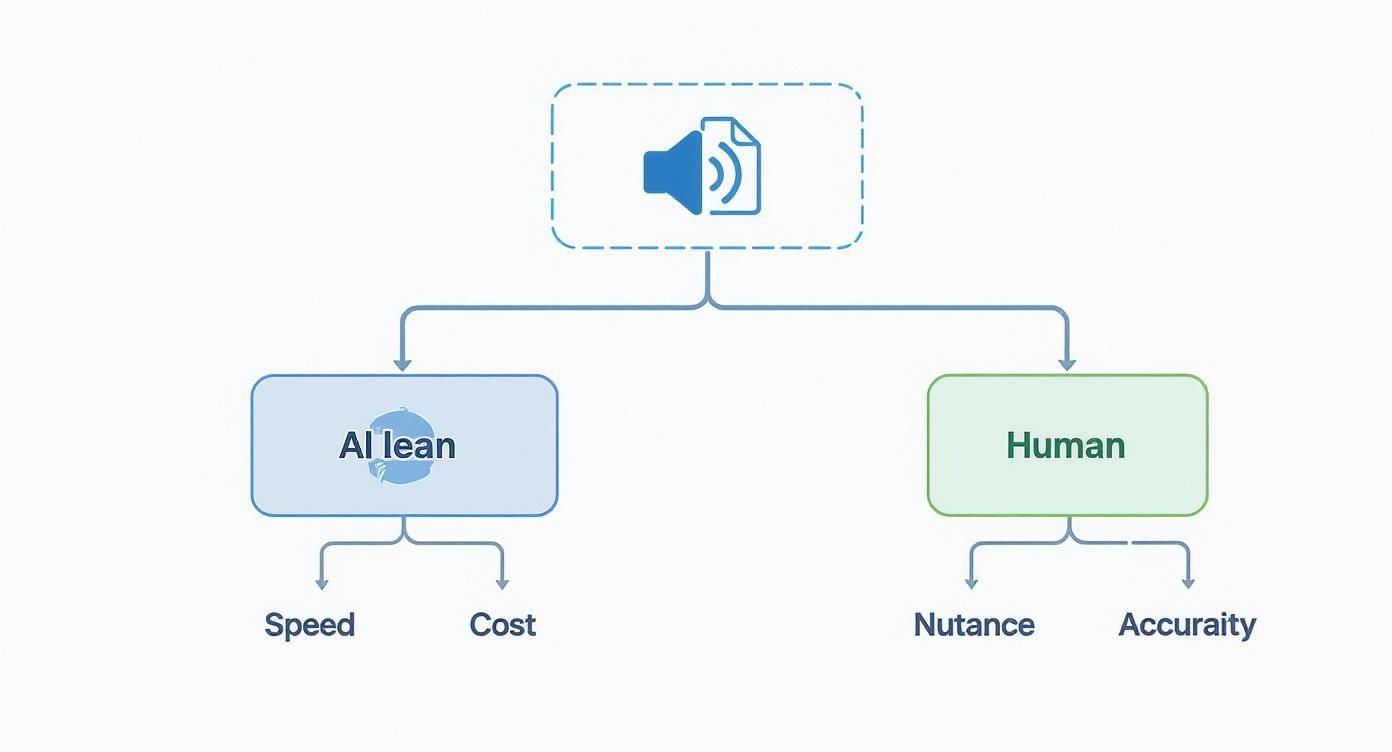
As you can see, the choice boils down to your priorities. If speed and cost are most important, AI is your go-to. If you need flawless contextual accuracy and subtlety, a human translator is the right choice.
The demand for this technology is surging. The global speech-to-speech translation market was recently valued at USD 0.56 billion and is expected to grow by about 10.09% annually through 2030. This isn't just a niche tool; it reflects a global need for faster language conversion.
Once the AI has finished, you can typically export the final text in various formats, such as .txt, .docx, or .srt for video subtitles.
Polishing Your AI-Generated English Translation
An AI translation provides a fantastic starting point, but it's rarely the final product. The real magic happens during human review, where you transform a functional but often robotic text into something that flows naturally. This step separates a decent translation from a professional one.
Think of the AI's output as a solid first draft. It usually captures the core information correctly but often misses the rhythm, idioms, and word choices that make English sound authentic. Your job is to smooth out these rough edges, ensuring the final text is not just accurate, but also clear and culturally appropriate for its audience.
A Practical Checklist for Your First Edit
When you first open the translated text, it can be hard to know where to start. A systematic approach works best. Begin by looking for common machine-generated errors before you focus on stylistic improvements.
Here’s a simple checklist I use to guide my review process:
- Literal Translations: Watch for German idioms translated word-for-word, which can sound strange in English. For instance, "Das ist mir Wurst" might become "That is sausage to me," when it actually means "I don't care."
- Grammatical Quirks: AI can get tangled in complex German sentence structures, leading to awkward phrasing in English. Don't hesitate to break up long sentences into shorter, clearer ones.
- Cultural Nuances: Ensure any references, humor, or cultural touchpoints are explained or adapted for an English-speaking audience. What’s common knowledge in Berlin might need context in Boston.
A crucial part of this process is spotting inconsistencies in terminology or tone. Consistent proofreading is just as important for translations as it is for original transcriptions. You can explore more on this topic in our comprehensive guide to proofreading in transcription.
Making the Translation Sound Human
After fixing the obvious errors, the next goal is to make the text read less like a machine wrote it. This is all about focusing on flow and natural language. As you refine the text, understanding how to make AI-generated content feel more authentic is a huge advantage. Resources on how to make AI content undetectable can offer valuable techniques.
Pay close attention to any regional dialects or slang that the AI might have misunderstood. A term from a Bavarian dialect, for example, could be completely misinterpreted by an AI trained on standard German. Correcting these specific errors is a key part of the process when you translate German audio to English, ensuring your final text is truly accurate and polished.
Handling Challenging Audio and When to Call a Pro
Let's be realistic: not all audio is created equal. An AI tool might handle a studio-quality podcast with ease, but a recording from a noisy trade show floor is a different challenge entirely. This is where you need to know how to manage messy, real-world files.
Before you attempt to translate German audio to English, listen to the file. Do you hear background chatter, wind noise, or multiple people speaking at once? These are the exact issues that can trip up an AI and reduce accuracy.
You can sometimes improve the AI's chances with a little preparation. Using basic audio software to filter out background noise or normalize the volume can make a significant difference. A cleaner signal almost always leads to a better initial translation.
Recognizing AI's Limits
Even with cleanup, there's a point where technology isn't the right tool. Knowing when to switch from AI to a human expert is a crucial skill, especially for important projects.
It’s probably time to bring in a professional translator when you’re dealing with:
- Thick Regional Dialects: An AI trained on standard Hochdeutsch will struggle with a strong Bavarian or Swabian accent.
- Multiple Overlapping Speakers: If you can barely distinguish who is saying what, an algorithm won't be able to either.
- Poor Audio Quality: Heavily distorted, muffled, or distant audio requires a human ear that can use context to fill in the gaps.
- High-Stakes Content: For legal contracts, medical records, or financial documents, the risk of a machine error is too high.
Hiring a professional isn't admitting defeat. It's making a strategic choice for projects where 100% accuracy and understanding subtle nuance are non-negotiable. Think of it as an investment in getting the job done right the first time.
There’s a reason the market for these services is thriving. In Germany alone, there are over 9,500 businesses specializing in translation and interpretation. This industry exists because for the toughest jobs, human expertise is irreplaceable. You can find more data on Germany's translation services market on IBISWorld.
Got Questions About German Audio Translation?
You're not alone. When you're converting German audio into English text, a few common questions always come up. Let's tackle them so you can move forward with confidence.
Just How Accurate is AI for German to English Audio?
For clear audio in standard German, the best AI tools are remarkably accurate, often exceeding 95% accuracy. For a clean podcast or a straightforward business meeting, the AI will likely perform very well.
However, the moment you introduce thick regional accents, background noise, or highly technical jargon, that accuracy can drop. AI is fantastic for getting the gist of a conversation or for internal notes, but if the final text is for public or official use, having a human review it is always a smart move.
Can I Translate Confidential German Audio Files Securely?
Absolutely, but you must choose your tools carefully. Reputable, paid AI platforms are built for security, offering end-to-end encryption and compliance with privacy laws like GDPR. A good rule of thumb is to avoid free, browser-based tools for sensitive material.
If you're dealing with highly sensitive information, such as legal proceedings or proprietary research, nothing beats a professional human translator working under a signed non-disclosure agreement (NDA). It's the gold standard for a reason.
What’s the Absolute Fastest Way to Translate a Long German Recording?
When time is critical, AI is your best friend. There's no contest here. An automated service can process an hour-long audio file and deliver a full transcription and translation in just a few minutes.
A human professional, on the other hand, would need several hours, or even a day or two, depending on their workload. For a quick first draft, a summary of a long lecture, or simply to find out what was said, AI is the undisputed champion.
Ready to turn your German audio into accurate English text? At meowtxt, our AI tool makes it incredibly simple. You can convert your files, translate them into over 100 languages, and grab the output in any format you need. Give it a try for free.


