
If you need to translate Chinese speech to English, the most effective way is to use an AI-powered service. These tools can take spoken audio and turn it into accurate, timestamped English text in just a few minutes. They go far beyond what traditional apps can do, easily handling different dialects, multiple speakers, and providing ready-to-use formats like SRT for video captions.
Why Accurate Chinese Speech Translation Is a Game Changer
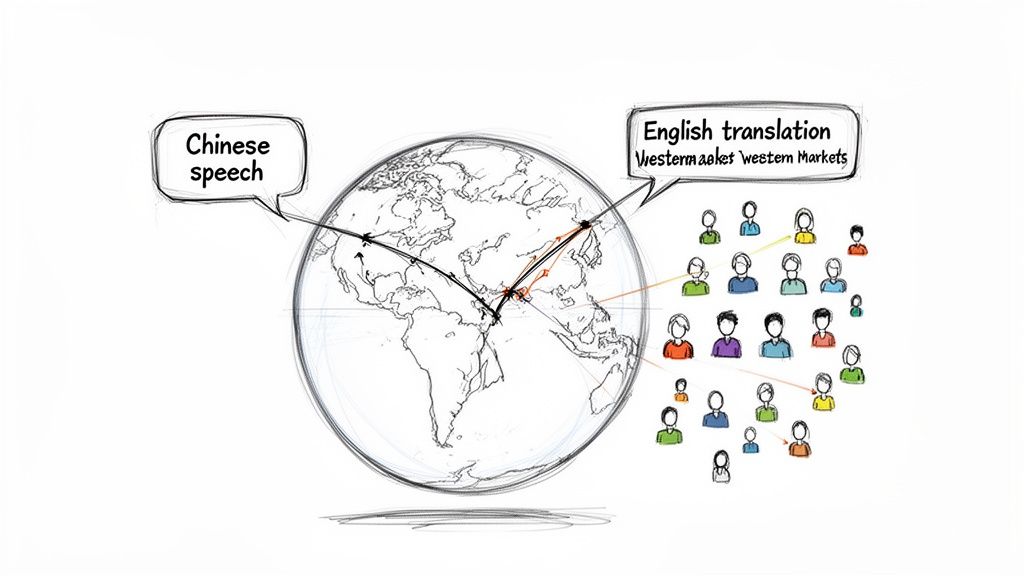
Breaking the language barrier between Chinese and English opens the door to a massive global audience. The opportunity is huge, but let's be honest—most common translation tools just aren't up to the task when it comes to the nuances of spoken Mandarin.
This often leads to confusing or hilariously wrong results that can completely undermine your message. Think of it like a game of telephone; subtle meanings, idioms, and cultural context get lost along the way. For a podcaster, a powerful interview can turn into nonsense. For a business, a critical deal point might get completely mangled.
Unlocking a Global Audience
The sheer scale here is staggering. By 2025, Chinese speakers will represent 20% of all global internet users, with over 980 million in China alone. Despite this, only about 1% of online content is actually in Chinese, creating a massive content gap.
This means that podcasts, YouTube videos, and business meetings held in Chinese are reaching just a fraction of their potential audience. There's a huge, underserved market out there just waiting for English versions of great content.
This is exactly where modern AI solutions step in. They offer a reliable and efficient way to translate Chinese speech to English with real precision, moving beyond clunky, word-for-word exchanges to capture the speaker's true intent.
The real goal isn't just transcription; it's about conveying the full meaning. I once translated a business negotiation where a speaker used a Chinese idiom about "adding flowers to a brocade." A literal translation would be gibberish, but an AI tool that understood the context correctly rendered it as "making a good thing even better."
The Power of Modern AI Translation
Modern tools use advanced Automated Speech Recognition (ASR) to first create an incredibly accurate text transcript of the original Chinese audio. If you want to dive deeper, you can learn more about what is ASR and how it works in our detailed guide. With a clean and precise source text, the translation engine can then produce far better results.
Comparing Free Tools with Specialized AI Solutions
Here’s a quick look at why generic tools often fall short for spoken Chinese compared to a dedicated AI translation service.
| Capability | Standard Free Tools | Specialized AI (like Meowtxt) |
|---|---|---|
| Dialect Handling | Struggles with anything beyond Standard Mandarin. | Trained on diverse regional accents and dialects. |
| Speaker Identification | Mixes all speakers into a single block of text. | Automatically detects and labels each speaker. |
| Contextual Nuance | Often produces literal, nonsensical translations of idioms. | Grasps idiomatic expressions and cultural context. |
| Accuracy | Prone to frequent errors, especially with background noise. | Delivers high accuracy, even in less-than-perfect audio. |
| Output Formats | Usually just plain text. | Offers multiple formats (SRT, DOCX, TXT) for different uses. |
Specialized services are built to overcome the hurdles that trip up basic apps. They don't just convert words; they translate meaning, making your content accessible and genuinely impactful for a global audience.
Setting Your Audio Up for Translation Success
To get a reliable translation from Chinese speech to English, you first have to capture clean audio. It’s pretty simple: if a human has to strain to understand what’s being said, an AI is going to struggle even more.
The quality of your source recording is the single biggest factor in getting an accurate translation.
Think of it as the "garbage in, garbage out" rule of AI. A recording swimming in background noise, muffled voices, or people talking over each other forces the AI to guess. Those guesses lead directly to errors in your final English text. A few extra minutes of prep work up front can literally save you hours of painful editing on the back end.
Your Microphone and Recording Space Matter
You don't need a professional studio, but your smartphone's built-in mic probably isn't the right tool for an important project. Even a budget-friendly external microphone—like a simple lavalier (lapel) mic or a USB mic—can make a massive difference by capturing the speaker's voice directly and cutting out room noise.
Once you have a decent mic, turn your attention to the environment. A few simple tweaks can dramatically improve your audio quality:
- Find a quiet spot. Close the windows and doors to shut out street noise or chatter from the next room.
- Kill the echo. Recording in a room with soft surfaces like a carpet, curtains, or even a walk-in closet full of clothes will absorb sound and stop it from bouncing around. Hard, empty rooms are your enemy.
- Watch your distance. Keep the mic a consistent 6-8 inches from the speaker's mouth. This helps maintain a steady, clear volume level.
For a deeper dive, our guide on how to improve audio quality for transcription is packed with more techniques, from software settings to hardware recommendations.
The Human Factor: Clarity and Dialects
Beyond the gear, the way people speak is just as critical. The best AI models are trained on Standard Mandarin (Putonghua), so the closer your speaker is to that, the better your results will be.
Overlapping conversations are a nightmare for any transcription service. Make a point to ask speakers to talk one at a time. It might feel a bit unnatural in a fast-moving meeting, but it's essential for getting a clean transcript. If someone mumbles or speaks too quickly, the AI is more likely to misinterpret words, creating a domino effect of translation errors.
A classic mistake I see all the time is someone trying to record a big meeting with one omnidirectional mic placed in the middle of a long table. The people sitting right next to it come through loud and clear, but everyone at the ends of the table sounds faint and echoey. The result is a transcript that's only half-accurate and nearly impossible to translate reliably.
By taking the time to set up your recording space and get everyone speaking clearly, you're feeding the AI the high-quality data it needs to perform well. This preparation is the true foundation for a flawless translation.
Your Guide to AI-Powered Chinese to English Translation
So you’ve got your audio prepped and ready to go. What’s next? Moving from a raw recording to a finished English translation is surprisingly simple. Modern tools have cut out all the technical nonsense, letting you focus on the final product, not the process. Let’s walk through how a service like Meowtxt can translate Chinese speech to English in just a few clicks.
The whole workflow is designed to be intuitive. You kick things off by uploading your audio or video file—it could be an MP3 from a podcast, an MP4 of a business meeting, or a WAV file from a formal interview. As soon as your file is uploaded, the system gets to work, handling all the heavy lifting in the background.
This is where the AI really flexes its muscles. It doesn't just listen; it analyzes. The software starts by transcribing the spoken Chinese into text, but it also layers in crucial context that makes the information genuinely useful.
From Raw Audio to a Structured Transcript
This isn't about getting a giant wall of text back. A smart AI tool will do several things at once to give you a clean, organized document:
- Speaker Identification: It figures out when a new person starts talking and labels them accordingly (e.g., Speaker 1, Speaker 2). This is a total game-changer for interviews, panel discussions, or any recording with multiple voices.
- Timestamping: Every word or phrase gets tagged with a precise timestamp, showing exactly when it was spoken in the original audio. This is non-negotiable if you plan on creating video subtitles down the line.
- High-Accuracy Transcription: The AI converts the Mandarin speech into a clean, readable text file, creating a solid foundation for the translation.
Once the Chinese transcript is ready—usually in just a few minutes—the final part is even easier. With one more click, the tool translates the entire transcript into natural, accurate English. Crucially, all the speaker labels and timestamps are carried over, giving you a perfectly structured document that’s easy to navigate and use immediately.
The real magic is watching a two-hour Mandarin interview become a fully translated and timestamped English document in under ten minutes. It’s so fast it completely changes how you approach creating multilingual content.
This visual breaks down the simple audio prep needed for the best possible translation results.
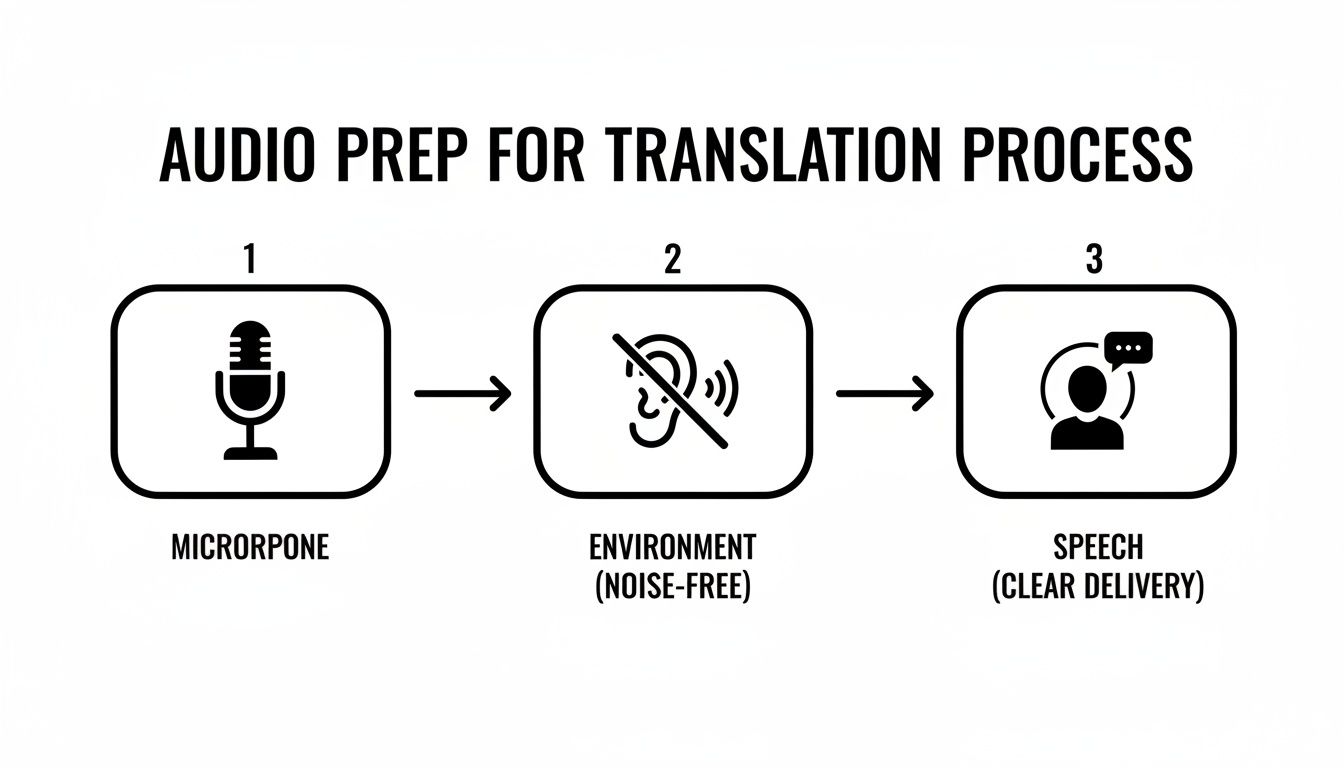
Starting with a decent microphone in a quiet room is the first step. That leads to clear speech, which is what fuels the AI's accuracy.
The Power of One-Click Translation
The technology is evolving at an incredible pace, making powerful tools like this more accessible than ever. To get the most out of it, it helps to understand related fields, like how cutting-edge AI voiceover technology works and what makes it effective for different types of content. Seeing how various AI tools can fit together in your workflow is key.
Ultimately, the goal is to make the process to translate Chinese speech to English feel less like a technical chore and more like a simple, everyday capability. If you want a more detailed look at the entire process from start to finish, you might find our guide on how to translate audio to English helpful.
Refining and Exporting Your Translated Content
AI gets you most of the way there, but the last 5% is what separates a decent translation from a great one. Think of the AI's output as a really strong first draft, not the final product. This last step—a quick human review—is where you smooth out the rough edges and make sure the text flows perfectly.
This isn't about starting over. It’s a focused check to catch the subtle things an algorithm might miss. A good online editor lets you play the original audio and follow along with the translated text, making quick fixes as you go.
Making Quick and Effective Edits
The editing phase is your chance to fix minor but important details. The goal is simple: make the text sound like it was written by a native English speaker.
Here’s my mental checklist for a quick review:
- Proper Nouns and Names: AI is smart, but it can stumble on a specific company name or an uncommon personal name. A quick scan ensures everyone and everything is identified correctly.
- Technical or Industry Jargon: If your audio gets into niche topics, like medical terms or engineering specs, you might need to swap a word or two to match the standard industry lingo.
- Cultural Nuances: This is a big one. A direct translation can sometimes miss the mark. A Chinese expression of politeness, for example, might sound overly formal or just plain awkward in English. These are the moments you can rephrase to feel more natural.
Spending just a few minutes on this review elevates the quality from "good enough" to professional and polished. You want a translation that doesn't feel like a translation at all.
Choosing the Right Export Format for Your Needs
Once you're happy with the text, the last move is getting it out in a format that works for your project. This is a crucial part of how you translate Chinese speech to English for practical use—moving the text from the tool into your actual workflow.
Different projects demand different file types. A flexible tool won’t just spit out a block of plain text; it will give you structured files ready for specific platforms.
Having the right export option is a huge time-saver. For my YouTube channel, getting a ready-to-upload SRT file means I can add perfect captions in seconds, not hours. It’s the difference between publishing content today or putting it off until tomorrow.
Let's break down the most useful formats:
| File Format | Best Use Case | Why It Works |
|---|---|---|
| SRT | Video Subtitles for platforms like YouTube, Vimeo, or social media. | Contains text and precise timestamps that automatically sync captions with your video's audio. |
| DOCX | Meeting Notes or Reports for sharing with teams, creating articles, or formal documentation. | A standard, editable document format that preserves formatting and is universally compatible with word processors. |
| TXT | Raw Text for blog posts, website content, or simply keeping a basic record of the conversation. | A lightweight, plain text file that's easy to copy and paste into any application without extra formatting. |
| JSON | Developer Use for integrating translated content into custom applications, websites, or software. | A structured data format that makes it easy for developers to parse and use the transcript programmatically. |
Ultimately, having these choices means your translated content is ready for action the moment you export it, whether you're a content creator adding captions to a video or a business professional sharing detailed meeting minutes with your team.
Real-World Workflows for Creators and Businesses
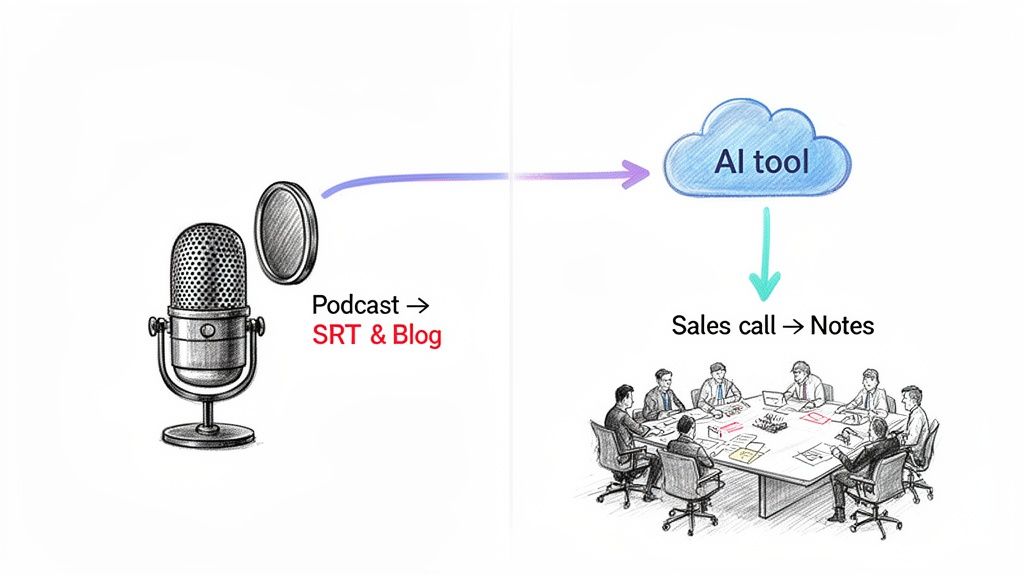
Theory is one thing, but let's talk about how these tools actually solve real problems on the ground. Seeing how you can translate Chinese speech to English in a couple of common scenarios really shows how valuable this tech can be.
Think about a podcaster who just nailed an insightful interview with an entrepreneur in Mandarin. The big goal now is to open that conversation up to a much wider English-speaking audience. Or picture a sales team that just recorded a call with a potential partner in China. They desperately need to pull out clear takeaways and action items for colleagues who don't speak the language.
These aren't just hypotheticals—they're daily hurdles for global creators and businesses. The right AI tool can take a single audio file and spin it into several valuable assets, saving a ton of time and manual effort along the way.
For Podcasters and YouTubers
Let's go back to our podcaster. The workflow here is pretty direct. They upload their interview audio, and the AI gets to work, automatically transcribing the Mandarin and—crucially—identifying both the host and their guest.
Timestamps and speaker labels are the unsung heroes of this whole process. They make it ridiculously easy to find key moments in a long interview or to correctly attribute quotes without having to scrub through the audio file again and again.
With a perfect transcript in hand, the podcaster can now do two things instantly:
- Generate an SRT File: With a single click, a perfectly synced subtitle file is ready. They can upload this straight to their YouTube channel, making the video immediately accessible to a global audience.
- Create a Blog Post: The full English translation can be exported as a DOCX or TXT file. This file becomes the perfect foundation for a detailed blog post, packed with direct quotes and show notes, which is great for SEO and audience engagement.
For Business Meetings and Sales Calls
The sales team’s needs are a bit different. They aren't creating public content; they're after internal clarity and absolute accuracy. Once their call recording is processed, the AI gives them a full English transcript with each speaker clearly labeled.
This lets them pinpoint key agreements, objections, and action items that came up during the call. The ability to translate Chinese speech to English with this much detail ensures nothing important gets lost in translation. From there, they can share a quick summary or the full transcript with their team, making sure everyone is on the same page about what happens next.
This isn't just a "nice-to-have." In a global market, it's essential. By 2025, translating content into just eight key languages is projected to unlock 80% of global online purchasing power. China's internet user base alone is a staggering 980 million people, highlighting the huge demand for accessible content. You can learn more about translation's impact on global e-commerce from Redokun. Workflows like these make tapping into that potential much, much easier.
Common Questions About Chinese Speech Translation
So, you're diving into the world of Chinese audio translation. Awesome. But as you probably know, a few questions always pop up—especially around dialects, multiple speakers, and those weird file formats like SRT. Getting these details sorted out is what separates a messy, confusing translation from a polished, professional one.
Let's walk through the common hurdles and clear them up.
How Accurate Is AI Translation for Different Chinese Dialects?
This is a big one. The short answer is: it depends on the dialect.
For Standard Mandarin (Putonghua), the accuracy is fantastic. With a clear recording, you can expect up to 97.5% accuracy. Why? Because that’s the dialect most AI models have been trained on for thousands of hours. It’s their native tongue, so to speak.
But what about regional dialects like Cantonese, Sichuanese, or Shanghainese? Here's where it gets a bit more nuanced. A good AI can handle moderate accents without much trouble, but really thick dialectal speech can throw it for a loop, leading to more errors.
If you’re working on a critical project with a heavy regional dialect, the best practice is to have a native speaker give the final English text a once-over. They’ll catch the subtle meanings and cultural context that an AI might miss. The closer your audio is to Standard Mandarin, the smoother the ride will be.
Can I Translate a Video File with Multiple Speakers?
Yes, absolutely. This is exactly what modern AI tools are built for.
When you upload a video file—say, an MP4 from an interview or a panel discussion—the tool first strips out the audio track. Then, the magic happens. A feature called speaker identification (or diarization) kicks in, automatically detecting who is talking and when.
The result is a clean, organized transcript with labels like 'Speaker 1' and 'Speaker 2'. When you translate that transcript into English, those labels stick around. It's a lifesaver for keeping track of conversations in interviews or team meetings, ensuring you never lose track of who said what.
What Is the Difference Between an SRT File and a TXT File?
This question comes down to what you plan to do with your translated text. The format you choose really matters.
- A TXT file is just plain, simple text. It’s your translated words in a document, perfect for pasting into a blog post, summarizing meeting notes, or just keeping a clean record of a conversation.
- An SRT (SubRip Subtitle) file is purpose-built for video captions. It’s a specialized format that contains not only the text but also precise timestamps that tell a video player exactly when to show each line on the screen.
If you upload an SRT file to YouTube or Vimeo, the captions sync up perfectly with your video. It’s how you make your content accessible to a global audience.
Choosing the right export format is about making your content work for you. An SRT file turns a great video into a globally accessible one, while a TXT file gives you the raw material for articles, social media posts, and more. It’s all about maximizing the value of your original recording.
Is My Data Secure When I Upload Audio for Translation?
Security is a totally valid concern, especially with sensitive business meetings or personal projects.
Reputable services take this seriously. Look for platforms that use end-to-end encryption, which protects your files while they’re being uploaded, processed, and stored.
An even bigger sign of a commitment to your privacy is an automatic deletion policy. This means your audio and transcript files are permanently wiped from the servers after a set period, like 24 hours. Always give the privacy policy a quick scan, but an auto-delete feature is a strong indicator that the service respects your data.
Ready to turn your Chinese audio into accurate English text? Meowtxt offers a fast, secure, and intuitive platform to transcribe and translate your content with just a few clicks. Try it free today and see how easy it is to bridge the language gap.


