
Legal transcription is the specialized craft of converting spoken words from legal proceedings—like depositions, courtroom hearings, and witness interviews—into a precise, verbatim written document. This official transcript serves as a certified record of every word spoken, ensuring absolute accuracy for court filings, case preparation, and appeals.
What Is Legal Transcription and Why It Matters
Imagine trying to build a legal argument from memory alone. It’s simply impossible. Legal transcription provides the official blueprint for a case by turning audio and video recordings into a tangible, verifiable written record. This isn't just typing; it's a meticulous process that captures the complete spoken history with unflinching accuracy.
In the legal field, every nuance matters. A slight hesitation, an interruption, or a specific turn of phrase can alter the course of a case. Professional legal transcription ensures none of these critical details get lost, forgotten, or misinterpreted.
The Bedrock of Legal Proceedings
These documents are far more than mere notes. They are foundational tools used by attorneys, paralegals, and judges at every stage of the legal process. A high-quality transcript is the indisputable source of truth, making it essential for several critical tasks.
Here's where a legal transcript truly proves its worth:
- Case Strategy and Analysis: Lawyers meticulously review transcripts to identify strengths, weaknesses, and inconsistencies in testimony, which helps them build a powerful case strategy.
- Creating an Official Record: Certified transcripts become part of the formal court record, creating a permanent account of proceedings that can be referenced during trials and appeals.
- Impeaching Witness Testimony: If a witness's story on the stand contradicts their deposition, the transcript is the ultimate tool for challenging their credibility.
- Ensuring Accessibility: Transcripts make legal proceedings accessible to individuals who are deaf or hard of hearing, upholding fairness and legal compliance.
A single mistranscribed word can have a domino effect, potentially altering the meaning of a statement and jeopardizing an entire case. For legal transcription, precision isn't just a goal—it's an absolute requirement.
Legal transcription services are fundamental to the justice system, providing the accurate records needed for critical tasks like deposition preparation. Without them, the integrity of spoken evidence would be at serious risk.
This entire process underpins the structure of our legal system. It safeguards fairness by ensuring every word spoken is officially documented, reviewed, and held accountable. From the initial client meeting to the final verdict, a reliable transcript is an indispensable asset for any legal professional.
Why the Demand for Spot-On Legal Records is Exploding
The need for professional legal transcription is not just growing; it's accelerating. Two major forces are driving this surge: the increasing complexity of modern legal cases and the massive, industry-wide shift toward remote and digital proceedings.
As legal battles become more intricate, the volume of spoken evidence has ballooned. We're no longer talking about a single afternoon in a courtroom. Today's cases are built on hours of pre-trial depositions, witness interviews, client calls, and arbitration sessions—many of which now happen virtually.
This digital wave means law firms, courts, and government agencies are navigating a sea of audio and video files. Every one of those files contains critical information that must be documented perfectly. This is where the real demand for specialized legal transcription services ignites.
The New Normal: Virtual and Digital Evidence
The move to remote work has permanently reshaped legal workflows. Virtual depositions over video calls are now standard practice. While they save significant time and travel costs, they also create a new challenge: capturing every single word with courtroom-level accuracy from a digital source.
This shift has made reliable transcription a non-negotiable part of the modern legal toolkit. Without it, a firm would face the time-consuming and inefficient task of manually scrubbing through hours of recordings.
- Virtual Depositions: Capturing testimony from witnesses across the country generates hours of video that must be transcribed into an official, searchable record.
- Digital Evidence: Audio from body cams, surveillance footage, and recorded phone calls are now routine forms of evidence. They all require precise written transcripts for analysis and presentation in court.
- Remote Hearings: Many preliminary hearings and motions now occur virtually, and a transcript is often the only official record of what was decided.
At the end of the day, it doesn't matter if you're in a physical courtroom or on a video call—every spoken word must be documented with absolute precision. The shift to digital simply increases the volume and urgency.
This is not a temporary trend. It's a fundamental change in how the legal system operates. Efficient, scalable transcription is no longer a luxury; it's a necessity for any legal practice that wants to remain competitive.
A Global Industry Answers the Call
This explosive growth is reflected in the market itself. The global legal transcription market was valued at $2.395 billion USD and is projected to reach $4.99 billion by 2035, expanding at a compound annual rate of 6.9%. What’s fueling this? The rising complexity of cases and the endless digital recordings of depositions, hearings, and trials that all demand a perfect paper trail. North America currently leads this market, thanks to its high volume of litigation and deeply established legal frameworks. You can explore more data on the legal transcription market's growth on Market Research Future.
This expansion underscores just how indispensable these services have become. Legal professionals everywhere now rely on accurate, timely, and secure transcription to manage their caseloads effectively. The ability to instantly convert spoken words into searchable, analyzable text is a genuine game-changer for building a case and crafting a winning strategy.
Ultimately, the surging demand for legal transcription is a direct response to a legal world that's more complex, more digital, and moving faster than ever. Having a rock-solid method for creating accurate records is the key to navigating this new reality successfully.
Navigating Strict Formatting and Compliance Standards
What transforms a simple typed conversation into a legal document you can confidently use in court? A rigid set of formatting and compliance rules. Legal transcription isn't just about getting the words right; it's about structuring the document to guarantee its integrity within the justice system.
Think of it this way: a standard transcript is a rough sketch, but a court-ready transcript is a detailed architectural blueprint. Every line, label, and measurement in the blueprint serves a purpose. Any deviation can compromise the entire structure. The same applies to legal transcripts, where strict rules govern everything from timestamps to noting a cough.
These aren't mere suggestions. These standards give a legal record its authority, ensuring every transcript is a reliable and universally understood account of what was said.
The Anatomy of a Court-Ready Document
A transcript destined for legal proceedings must contain specific elements, all formatted with precision. When combined, they create a complete picture of the recorded event, leaving no room for guesswork. A mistake in any of these areas could put the document's credibility—or even its admissibility—at risk.
Key formatting requirements include:
- Precise Timestamps: Marking the exact time of an utterance (e.g., [HH:MM:SS]) is crucial. It allows legal teams to jump directly to key moments in the original audio or video when reviewing evidence or preparing for cross-examination.
- Clear Speaker Identification: Each time a person speaks, they must be accurately identified. This is typically done with their name or role (MR. SMITH:, THE COURT:, WITNESS:), leaving zero doubt about who said what.
- Strict Verbatim Transcription: This is the cornerstone of legal transcription. It means capturing every single word exactly as it was spoken. This includes filler words ("um," "uh"), stutters, false starts, and grammatical errors. These details can reveal a speaker’s hesitation or state of mind, which can be critical to a case.
- Inclusion of Non-Verbal Cues: Important non-verbal sounds are also documented to add context. Details like [laughter], [crying], [papers shuffling], or [crosstalk] are noted in brackets to paint a fuller picture of the environment.
A legally sound transcript doesn’t just record words; it reconstructs the entire auditory scene. The goal is for someone reading the document to have the same understanding as someone who was actually present.
Before we move on, let's summarize the must-have elements that make a transcript officially "court-ready."
Key Elements of a Court-Ready Transcript
This table breaks down the essential components and formatting rules that make a transcript legally compliant and admissible.
| Component | Description | Why It's Critical |
|---|---|---|
| Title Page | Includes case name, number, date, and location. | Provides immediate, unambiguous context for the entire proceeding. |
| Speaker ID | Consistent labels (e.g., THE COURT:, MR. JONES:). | Eliminates any confusion about who is speaking at any given moment. |
| Timestamps | Placed at regular intervals or per utterance. | Allows for quick cross-referencing with the original audio/video evidence. |
| Verbatim Text | Captures every word, filler, and false start. | Preserves the speaker's original intent, hesitation, and state of mind. |
| Non-Verbal Sounds | Notes significant sounds like [laughter] or [door slams]. | Adds crucial environmental and emotional context to the spoken record. |
| Certificate Page | A signed statement by the transcriber affirming accuracy. | Serves as a sworn testimony to the transcript's integrity and authenticity. |
Each of these components works together to create an ironclad document that can withstand the scrutiny of the legal process.
Upholding Confidentiality and Professional Standards
Beyond the document's structure, the process of legal transcription is governed by strict confidentiality protocols. Legal matters are filled with sensitive information, from personal details to corporate secrets. Professional transcription services are bound by non-disclosure agreements (NDAs) and use robust security to protect that data.
This commitment to privacy is not just a courtesy; it's a legal and ethical mandate. Additionally, many top-tier transcriptionists and agencies pursue certifications from organizations like the American Association of Electronic Reporters and Transcribers (AAERT). These credentials aren't just for show—they signal proven expertise in legal terminology and a deep commitment to the high standards the justice system demands.
Ultimately, these combined rules of formatting and professional conduct ensure every legal transcript is accurate, trustworthy, secure, and ready for any legal challenge.
The Human Touch vs. AI-Automated Transcription
In the high-stakes world of legal transcription, the central debate is machine versus human. It's a classic matchup: the raw speed of artificial intelligence against the nuanced, contextual understanding of a human expert. The right choice ultimately depends on the intended use of the final transcript.
Automated transcription tools are incredibly fast, processing hours of audio in just minutes. This offers a quick, low-cost way to get a written record. For tasks like initial case reviews or sifting through large volumes of discovery audio, that speed can be a game-changer.
However, the legal field demands a level of precision that goes beyond just words on a page. While AI has made significant strides, it often stumbles over the very complexities that define legal conversations.
The Irreplaceable Value of Human Insight
A human transcriptionist brings something an algorithm cannot yet replicate: context. They don’t just hear words; they understand the intricate dynamics of a legal proceeding. This is what separates a rough draft from a reliable legal document.
Human experts master nuance in ways AI is not designed for:
- Navigating Complex Terminology: Legal language is its own world. An experienced transcriptionist is fluent in this dense dialect, correctly identifying and spelling arcane terms that would baffle an automated system.
- Deciphering Overlapping Speech: Courtrooms and depositions are rarely orderly. People often talk over each other. A human can skillfully untangle this crosstalk, attributing every word to the correct person.
- Interpreting Non-Verbal Cues: A human can capture the meaning behind a heavy sigh, a sarcastic tone, or a witness's sudden hesitation, noting these crucial details with precision.
- Ensuring Court-Ready Formatting: Professionals are experts in the strict formatting rules—from speaker IDs to certificate pages—that make a transcript admissible in court.
An AI might provide a rough draft, but a human expert delivers a certified record. They ensure every word and every ounce of intention is captured with the precision needed to withstand legal scrutiny.
The flowchart below breaks down the key standards—timestamps, speaker identification, and verbatim accuracy—that define a court-ready transcript. These are all areas where human oversight is absolutely essential.
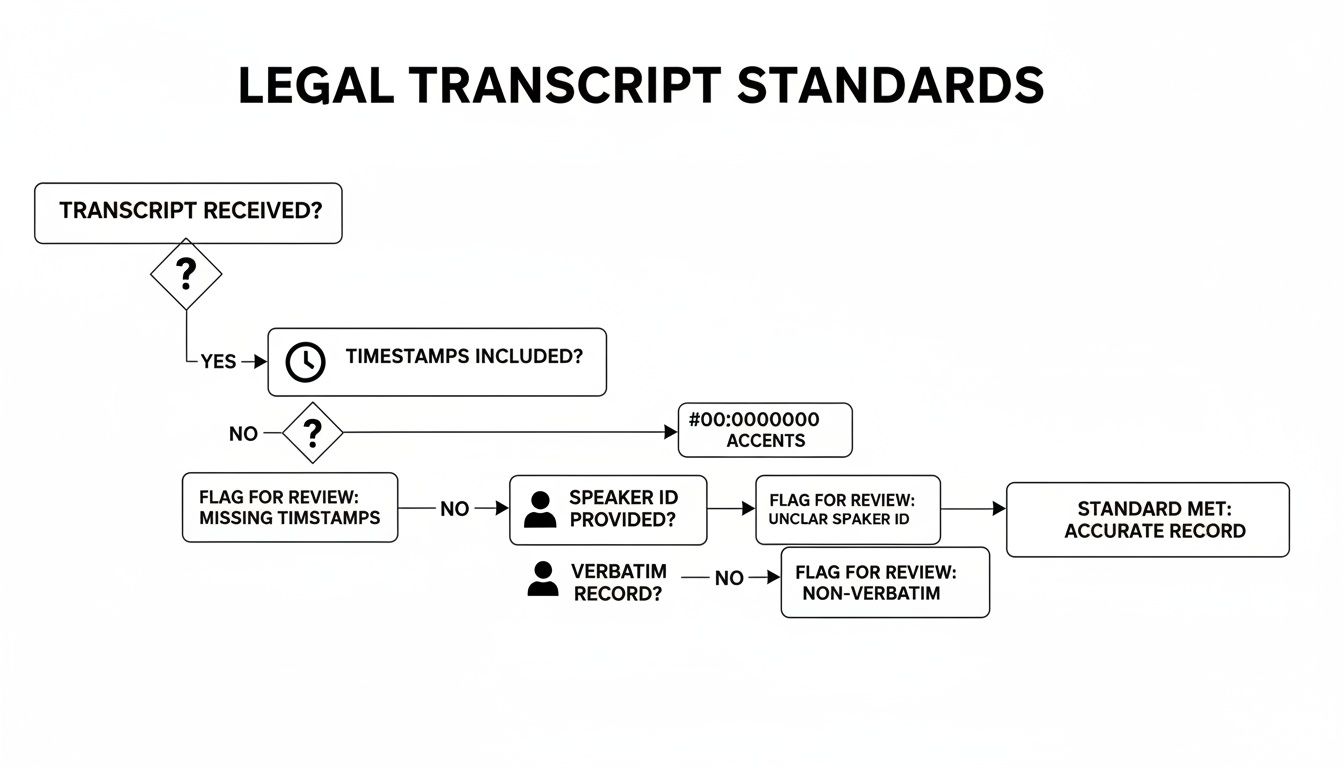
This visual shows how each element fits together to create an authoritative document, a task where human judgment remains the gold standard.
The Power of Automated Speed
That's not to say AI doesn’t have a powerful role to play. AI-driven transcription, powered by technology known as Automatic Speech Recognition (ASR), has become incredibly sophisticated. To understand the mechanics, you can explore what ASR is and how it works and see how advanced it has become.
Its true strength lies in processing bulk audio at lightning speed. Think of it as a first-pass tool. A paralegal can feed dozens of hours of recorded witness interviews into an AI service and receive searchable text almost instantly. This allows them to find key terms or topics in a flash without listening to every second of the recordings.
Finding the Best of Both Worlds: A Hybrid Approach
Increasingly, the smartest solution isn't an "either/or" choice but a blend of both. A hybrid model leverages the strengths of each, creating a workflow that is both incredibly fast and flawlessly accurate.
This approach typically looks like this:
- AI First Draft: An audio or video file is processed through an AI transcription service, generating a rough draft in minutes.
- Human Review and Editing: A professional legal transcriptionist takes the AI-generated text and meticulously polishes it, checking it against the original audio.
- Refinement and Certification: The human expert corrects any errors in terminology, speaker labels, and formatting. They add crucial non-verbal cues before certifying the document as a true and accurate record.
This method gives you the speed of automation with the uncompromising accuracy the legal system demands. It enables law firms to manage huge volumes of audio efficiently while guaranteeing the final transcript meets the rigorous standards required for any official proceeding. By marrying technology with human expertise, legal professionals get the speed they want without sacrificing the precision they absolutely need.
How the Stenographer Shortage Reshaped the Industry
For over a century, the courtroom had an iconic, nearly silent partner: the stenographer. Their lightning-fast keystrokes were the gold standard for creating the official legal record. But a quiet crisis has been brewing, creating a vacuum that has completely reshaped how the justice system documents its proceedings.
A severe and worsening shortage of court stenographers has forced the legal world to find new solutions. The need for accurate records didn't disappear—it intensified. This created the perfect environment for modern legal transcription services to step in, becoming not just an alternative, but an essential component of the legal world.
This was not a shift driven by convenience. It was a necessary adaptation to a critical workforce gap that threatened to grind the wheels of justice to a halt.
The Numbers Behind the Shortage
The decline in stenographers is not a minor trend; it's a statistical cliff dive. This shortage is the primary force fueling the demand for legal transcription, with courts nationwide scrambling for solutions.
In the last decade alone, the number of stenographers has plummeted by 21%. The pipeline is also drying up, with a 42% drop in stenography schools and a staggering 74% decline in enrollment. Today, 81% of the remaining stenographers are 45 or older, signaling a wave of impending retirements.
With 63% of legal professionals calling this crisis a major problem, the shift to digital recording and outsourced transcription has become unavoidable. The traditional method of creating court records is simply no longer sustainable.
The Rise of Digital Recording
As stenographers became harder to find, courthouses and law firms turned to digital audio and video recording systems. This move solved one problem—capturing what was said—but immediately created another.
Suddenly, legal professionals were inundated with digital files. An hour-long deposition was no longer a transcript waiting to be printed; it was an MP3 or MP4 file sitting on a server. This created an urgent, massive need for a service that could expertly convert those digital recordings into precise, court-ready documents.
This is exactly where legal transcription evolved from a niche service to a mainstream necessity. The industry stepped up to bridge the gap, offering the expertise needed to transform raw audio into the official records the justice system relies on. To appreciate how much things have changed, it helps in understanding what stenography entails and the specialized skill it requires.
The stenographer shortage didn't just open the door for legal transcription; it kicked it down. It forced the legal system to embrace digital workflows, making transcription the new engine for creating accurate records.
This transition highlights how the demand for legal transcription is deeply woven into the changing fabric of the legal profession itself. It’s a direct solution to one of the most pressing challenges facing the modern justice system, ensuring that even without a stenographer in the room, every single word is still meticulously documented.
How to Choose the Right Legal Transcription Partner
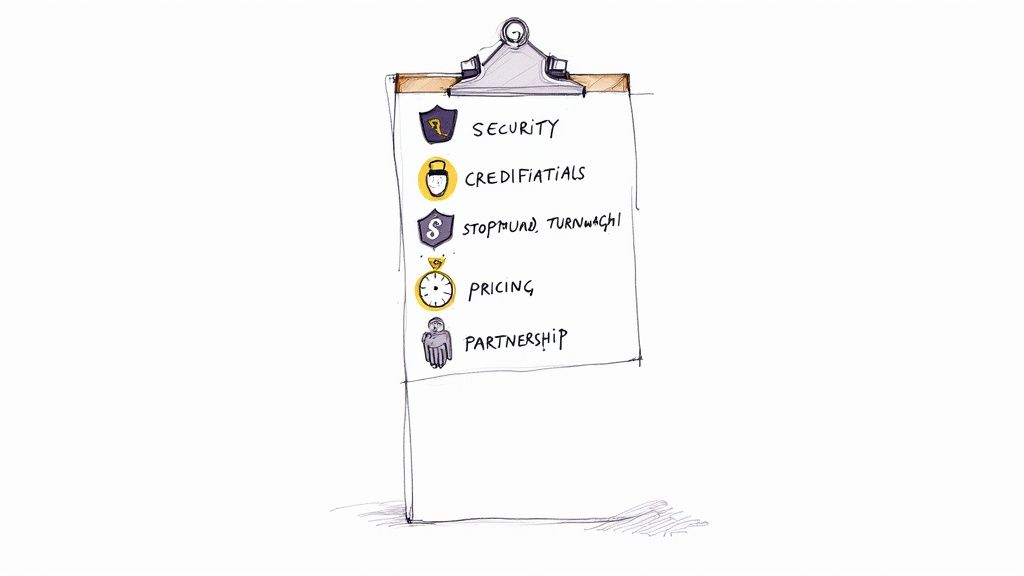
Selecting a legal transcription partner is a high-stakes decision that directly impacts your firm’s efficiency and integrity. This isn't just another administrative task; it’s a critical choice that demands a thorough evaluation of accuracy, security, and reliability.
Get it right, and your partner becomes a seamless extension of your legal team. Get it wrong, and you risk introducing errors and security vulnerabilities into your most sensitive cases.
First and foremost, look for a non-negotiable accuracy guarantee. In the legal world, the benchmark is 99% accuracy or higher. Anything less is a potential liability, where a single misplaced word could distort testimony or undermine a legal argument. You need to ask providers how they verify this—what does their quality control process look like? How do they ensure such high standards?
Vetting Credentials and Security
Confidentiality is the bedrock of the legal profession. Any partner you consider must demonstrate a real commitment to data security. This means looking for more than just a privacy policy; you need concrete, verifiable measures that protect your client's sensitive information.
Here are the absolute must-haves:
- Data Encryption: All your files—whether in transit or at rest—must be protected with strong encryption to prevent unauthorized access.
- Secure File Handling: The platform itself must be a fortress. The process for uploading and downloading files should be secure and user-friendly, leaving no room for data breaches.
- Non-Disclosure Agreements (NDAs): Every transcriptionist who handles your files must be bound by an ironclad NDA. This is not optional.
A provider’s credentials also speak volumes about their dedication. While certifications are not always required, they signal a commitment to the highest industry standards. Understanding the features of the platform itself is just as important; you can learn more about the essentials of top-tier legal transcription software to sharpen your evaluation.
Trust is the foundation of any successful partnership in the legal sector. A transcription service must prove it can be trusted with your most confidential materials before you ever send the first file.
Evaluating Turnaround and Pricing
Finally, you must consider the practicalities of speed and cost. Legal deadlines are unforgiving, so you need a partner who can deliver accurate transcripts on time, every time. Get clear answers on their standard and expedited delivery options to ensure they can keep pace with your caseload.
Pricing models vary widely, so find one that aligns with your firm’s budget and workflow. Common models include per-minute, per-word, or subscription plans. Get a transparent breakdown of their rates and watch out for hidden fees. A trustworthy partner makes it easy to see the value you're getting, ensuring the cost aligns with the quality and security you demand.
Common Questions About Legal Transcription
When dealing with legal transcription, a few practical questions always arise. Getting clear answers is the first step toward making an informed decision, whether you are outsourcing for the first time or considering a new provider.
Let’s address the most common queries we hear from attorneys, paralegals, and court reporters.
What Accuracy Level Should I Expect?
In the legal field, there is no margin for error. The absolute minimum benchmark for any legal transcript is 99% accuracy. This isn't just a desirable feature; it's a strict requirement.
An accuracy rate of 99% or higher ensures the transcript is a true verbatim record, capturing every word, stammer, and pause exactly as it occurred. Anything less introduces ambiguity that could jeopardize a document's integrity or even its admissibility in court.
How Is Confidentiality Protected?
Any reputable transcription service understands that security is non-negotiable. Protecting client confidentiality is a multi-layered process that begins with secure, end-to-end encrypted platforms for uploading and downloading your sensitive files.
Additionally, every human transcriptionist is bound by a strict non-disclosure agreement (NDA). Always ask a potential provider about their security protocols and compliance with data protection laws before sending them any files.
A professional legal transcription service understands that your client's data isn't just a file—it's a responsibility. Robust security isn't a feature; it's the foundation of their business.
What Is Verbatim Transcription?
Verbatim transcription is the gold standard for legal work. It means the final document captures everything that was said, exactly as it was said.
This includes filler words like "um" and "uh," false starts, stutters, and even significant pauses. Why is this important? Because in a legal context, how something is said can be as crucial as what is said. A "clean read" transcript, which removes these elements for readability, is completely unsuitable for any official legal record.
How Much Do Transcription Services Cost?
The cost of legal transcription is not one-size-fits-all. Pricing can vary significantly based on several key factors: the quality of the audio, the number of speakers, the required turnaround time, and whether you need verbatim transcription with timestamps.
To see how these variables influence pricing, our detailed guide on what transcription services cost breaks it all down, helping you budget effectively for your firm's needs.
Ready to turn your legal audio into accurate, searchable, and secure text? Meowtxt delivers a solution built for the high-stakes demands of legal professionals. Get started with Meowtxt today and discover what a perfect transcript can do for your workflow.


