
Imagine crafting one stellar piece of content—a detailed podcast, an insightful webinar, or an engaging video—and transforming it into ten, twenty, or even fifty different assets. That's not magic; it's the power of smart content repurposing. In a world where consistent, high-quality content is the key to growth, multiplying your output without multiplying your effort is the ultimate competitive advantage. You're already sitting on a goldmine of material; you just need the right map to uncover its full potential.
This guide provides exactly that: a prioritized, actionable roundup of 10 powerful content repurposing strategies designed for creators, marketers, and business teams. We'll move beyond generic advice and dive deep into specific workflows. You will learn how to leverage transcripts—your secret weapon for efficiency—to create an entire content ecosystem that drives traffic, engages audiences, and builds brand authority. Each strategy includes clear use cases and distribution channels so you can track your success.
The goal is to stop the content creation hamster wheel and start building a sustainable system. By mastering these techniques, you ensure every piece of content you produce works harder, reaching new audiences long after its initial publication. To explore even more techniques for multiplying your output, check out these effective content repurposing strategies for additional ideas.
Let's unlock the hidden value in the content you’ve already created.
1. Transcription to Blog Posts and Articles
Turning your audio and video content into detailed, written articles is one of the most effective content repurposing strategies you can leverage. This method involves taking the transcript from a podcast, webinar, or video and transforming it into a fully-fledged blog post. This approach opens up your valuable insights to a new audience that prefers reading, and it significantly boosts your SEO efforts by creating indexable, keyword-rich text that search engines love.
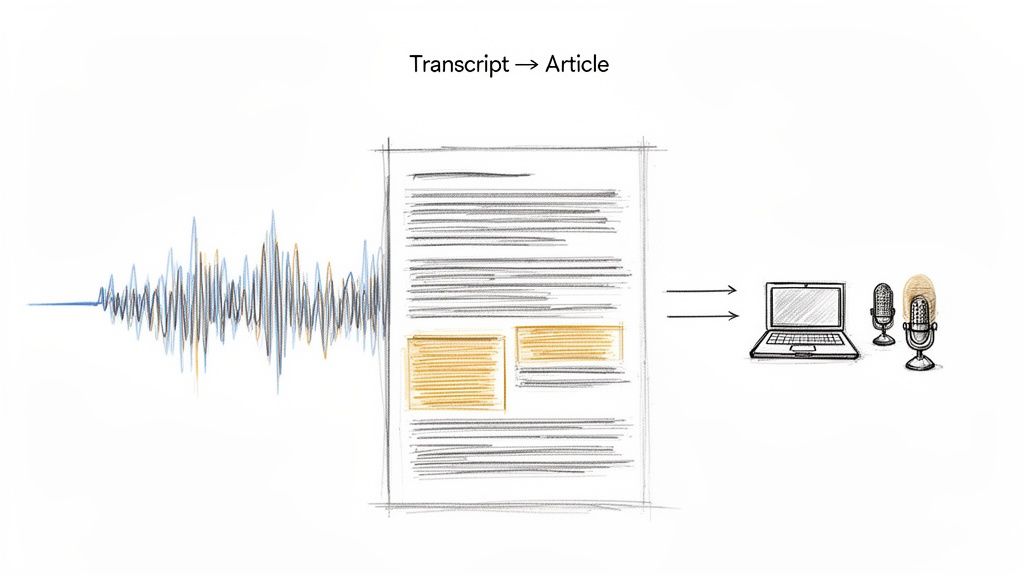
This approach is championed by industry leaders like Pat Flynn of Smart Passive Income, who consistently converts his podcast episodes into comprehensive blog posts. Similarly, HubSpot repurposes its webinar recordings into detailed guides, capturing search traffic long after the live event has ended. The core idea is to leverage the depth of your spoken content for written formats that attract organic traffic.
How to Implement This Strategy
A high-quality transcript is the foundation of this process. Using an accurate transcription service like MeowTxt, you can get a clean text file that requires minimal editing, saving you hours of manual work.
- Generate a Transcript: Upload your audio or video file to generate an accurate, time-stamped transcript.
- Edit and Structure: Export the transcript as a DOCX or TXT file. Clean up the text, fix any grammatical errors, and remove conversational filler. Restructure the content by adding compelling H2 and H3 headings, bullet points, and short paragraphs to improve readability.
- Enhance and Optimize: Add an introduction and conclusion to frame the content as a standalone article. Incorporate relevant keywords you want to rank for, weaving them naturally into the text. Add images, charts, and pull quotes to make the post more engaging. For an in-depth guide on this process, learn more about turning audio into text on meowtxt.com.
Pro-Tip: If your content features multiple speakers, use a transcription tool with speaker identification. This makes it easy to format interviews or panel discussions into a clear, readable Q&A-style article.
2. Video Clips and Highlight Reels
Extracting short, engaging video clips from longer content is a powerhouse among content repurposing strategies, especially for social media. This method involves identifying the most impactful moments from a podcast, webinar, or long-form video and turning them into bite-sized highlight reels. By doing so, you can capture attention on platforms like TikTok, Instagram Reels, and YouTube Shorts, driving engagement and leading new audiences back to your original content.
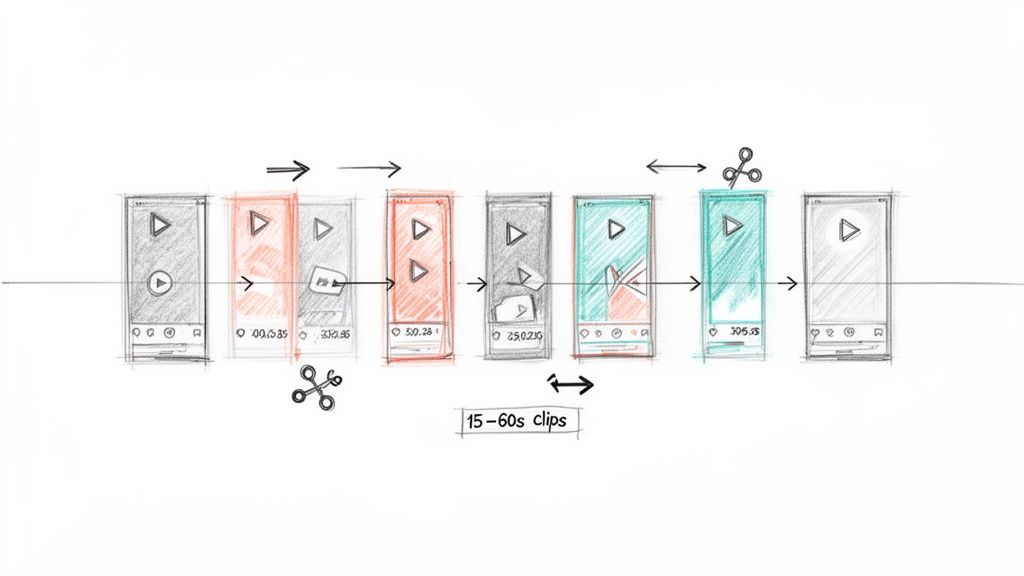
This strategy has been popularized by major creators like Gary Vaynerchuk, who systematically carves his keynote speeches into hundreds of social media assets. Similarly, viral clips from The Joe Rogan Experience dominate platforms like YouTube Shorts, attracting millions of views from audiences who may not have time for a three-hour podcast. The goal is to isolate high-impact soundbites that can stand alone and spark curiosity.
How to Implement This Strategy
A detailed transcript is your roadmap for finding gold within your long-form content. Using a tool like MeowTxt, you can scan the text and use timestamps to pinpoint the exact segments to clip, dramatically speeding up your workflow.
- Generate a Transcript: Upload your long-form video or audio file to get an accurate transcript with speaker labels and precise timestamps.
- Identify Key Moments: Read through the transcript to find compelling quotes, powerful stories, or actionable tips. Note the start and end timestamps for each potential clip.
- Clip and Edit: Use a video editor to cut the 15-60 second segments identified from your transcript. Add captions for accessibility, as many users watch social videos with the sound off. You can use MeowTxt's SRT export for this.
- Optimize and Distribute: Format each clip for its target platform (e.g., vertical 9:16 for Reels and Shorts). Add engaging headlines, relevant hashtags, and a call-to-action in the description that links back to the full-length content.
Pro-Tip: Focus on moments that trigger an emotional response or deliver a clear "aha!" moment. These types of clips are the most likely to be shared, maximizing your reach and driving viewers to your primary content platforms.
3. YouTube Captions and Closed Captions
Adding accurate captions to your video content is a powerful, yet often overlooked, content repurposing strategy. This method involves converting your video's audio transcript into time-synchronized text that appears on-screen, making your content accessible to a much wider audience. Not only does this serve viewers who are deaf or hard of hearing, but it also caters to the vast majority of people who watch videos with the sound off.
This practice has been mastered by platforms like Netflix and TED, which use high-quality captions to reach global audiences and ensure accessibility compliance. For creators, accurate captions are a game-changer for SEO, as they make your video's entire spoken content indexable by search engines. YouTube's own data suggests that videos with captions see a significant increase in watch time and engagement, directly impacting their visibility and search ranking.
How to Implement This Strategy
The key to effective captions is accuracy and perfect timing, which is why starting with a precise transcript is crucial. Using a service like MeowTxt to generate a transcript and then export it in a caption-ready format simplifies the entire workflow.
- Generate a Time-stamped Transcript: Upload your video file to get an accurate transcript with precise timestamps for every word.
- Export as SRT: Export the transcript directly as an SRT (SubRip Subtitle) file. This format includes the text and the start/end times needed for YouTube to display the captions correctly.
- Upload and Review: In your YouTube Studio, upload the SRT file to your video. Play the video with captions enabled to check for synchronization and fix any minor timing issues or spelling errors for proper nouns. For a full walkthrough, you can find a guide on how to add captions to a YouTube video.
Pro-Tip: Once you upload an accurate caption file in your primary language, enable YouTube's auto-translate feature. This allows international viewers to instantly translate your captions into their native language, dramatically expanding your global reach with minimal extra effort.
4. Social media Quote Graphics and Infographics
Transforming spoken words into shareable visual assets is a brilliant way to extend the reach of your core content. This content repurposing strategy involves extracting memorable quotes, statistics, and key insights from your transcripts to create compelling graphics for social media. It allows you to distill the most impactful moments from a podcast or video into easily digestible, highly shareable visuals that capture attention on crowded feeds.

This method is widely used by thought leaders like Brené Brown and Simon Sinek, whose teams effectively turn profound statements from talks and interviews into viral graphics. Similarly, entrepreneurs often pull key statistics or data points from webinars to create infographics that establish authority and drive engagement on platforms like LinkedIn and Pinterest. The goal is to isolate golden nuggets from your audio or video and give them a second life as standalone visual content.
How to Implement This Strategy
A clean transcript is your treasure map for finding these impactful moments. By quickly scanning the text, you can pinpoint the most quotable sentences and statistics without re-listening to hours of audio.
- Identify Key Moments: Scan your transcript for powerful statements, surprising statistics, or actionable tips. Highlight any text that stands on its own and encapsulates a core idea.
- Design the Graphic: Use a design tool like Canva or Adobe Express to create your graphic. Choose a template or create a custom design that aligns with your brand’s visual identity (fonts, colors, and logo).
- Add Text and Attribution: Paste the quote or data point onto your design. Always include attribution by adding the speaker's name and citing the original source (e.g., "From the [Podcast Name] Podcast, Episode 5"). This maintains credibility and directs traffic back to your primary content.
Pro-Tip: Create a set of branded templates for different types of graphics (e.g., quotes, stats, tips). This streamlines the creation process and ensures all your social media visuals maintain a consistent, professional look and feel.
5. Email Newsletter Content Series
Transforming a single piece of long-form content into a multi-part email series is one of the most effective content repurposing strategies for nurturing your audience. This technique involves breaking down a transcript from a webinar, interview, or podcast into smaller, digestible segments delivered over several weeks. It extends the value of your core content, keeps your subscribers consistently engaged, and drives repeat traffic to your site.
This strategy is expertly used by creators like Lenny Rachitsky, whose "Lenny's Newsletter" often serializes deep-dive interviews into multi-part email threads. Similarly, newsletters like The Hustle and Morning Brew excel at repurposing detailed reports and podcast discussions into daily or weekly emails that hook readers. The goal is to deliver concentrated value in each email, compelling subscribers to open the next one.
How to Implement This Strategy
A clean, well-structured transcript is the raw material for a successful email series. An accurate transcript allows you to quickly identify the most compelling themes and pull quotes to build your campaign around.
- Generate a Transcript: Upload your long-form audio or video file to a service like MeowTxt to create an accurate transcript.
- Identify Key Themes: Review the transcript and identify 4 to 8 distinct subtopics, key insights, or compelling stories. Each of these will become an individual email in your series.
- Draft and Enhance Each Email: For each theme, copy the relevant transcript portion into an email draft. Write a brief introduction to provide context and a conclusion with a clear call-to-action or a question for reflection. Create a compelling subject line based on the core idea of that segment.
- Schedule and Automate: Set up the emails as an automated sequence in your email marketing platform. Ensure you include a link back to the original full-length content (e.g., the podcast episode or webinar recording) in each email.
Pro-Tip: In the first email of the series, include a brief bio of your guest or speaker and an overview of what subscribers can expect from the upcoming emails. This sets the stage and builds anticipation for the entire series.
6. Podcast Show Notes and Chapter Markers
Transforming a podcast transcript into detailed show notes with chapters is one of the most user-centric content repurposing strategies you can implement. This method involves creating a comprehensive summary with timestamps, key topics, guest information, and resource links. It dramatically improves the listener experience, boosts your podcast's discoverability in apps, and enhances its SEO value on your website.
This practice is a hallmark of top-tier podcasters like Andrew Huberman, whose Huberman Lab podcast provides meticulously structured notes, and Tim Ferriss, who offers exhaustive show notes for every episode. They use this format to make dense, long-form audio content easily navigable, allowing listeners to find and revisit specific segments without scrubbing through hours of audio.
How to Implement This Strategy
An accurate transcript with precise timestamps is the essential starting point for creating high-quality show notes. Using a tool like MeowTxt, you can get the raw data needed to build out a detailed guide for your listeners, saving significant time in the process.
- Generate a Timestamped Transcript: Upload your podcast audio to generate an accurate transcript where each word is tied to a specific timestamp.
- Identify Key Segments: Scan the transcript to identify major topic changes, key takeaways, guest introductions, and mentions of resources. Note the exact start time for each of these sections.
- Write and Format Notes: Structure your show notes with a clear table of contents at the top. For each chapter, write a compelling 1-2 sentence summary and link it to the corresponding timestamp. Include guest bios, social media handles, and links to all mentioned books, tools, or articles. To learn more about this workflow, see this guide on how to transcribe a podcast on meowtxt.com.
Pro-Tip: Add a "Key Takeaways" or "Highlights" section at the top of your show notes. Use bullet points to list the most valuable insights from the episode, giving new listeners a quick, scannable preview of why they should tune in.
7. Lead Magnet PDFs and Content Upgrades
Transforming detailed transcripts into downloadable lead magnets is a powerful way to grow your email list and nurture potential customers. This strategy involves taking the core content from a transcript and enriching it as a high-value PDF, such as a guide, checklist, or resource library. It’s an effective method for converting passive consumers into engaged leads by offering them a tangible asset in exchange for their contact information.
This technique is a cornerstone for many growth-focused entrepreneurs. Neil Patel frequently offers comprehensive PDF guides derived from his blog posts and video content, while Pat Flynn turns his podcast episodes into actionable resource guides for his audience. The goal is to package your expertise into a polished, easily digestible format that incentivizes sign-ups and moves subscribers further down your marketing funnel.
How to Implement This Strategy
The process begins with a clean, well-organized transcript that serves as the raw material for your downloadable asset. Using a tool that provides an easily editable export format is key to streamlining this workflow.
- Generate and Refine the Transcript: Upload your audio or video file to a service like MeowTxt to get an accurate transcript.
- Export and Design: Export the transcript as a DOCX file. Open it in a word processor or design tool to add branding, such as your logo, colors, and fonts. Structure the content with clear headings, bullet points, and visuals to enhance readability.
- Enhance and Package: Add value beyond the raw text. Create a summary checklist, a resource section with links, or a worksheet based on the transcript's key takeaways. Convert the final document into a PDF. Host it behind an email opt-in form on your website or a dedicated landing page.
Pro-Tip: Design a compelling cover page and include a clear call-to-action (CTA) at the end of the PDF. This CTA could direct readers to your flagship product, a consultation booking page, or another relevant piece of content, maximizing the value of each download.
8. Online Course Modules and Training Materials
Transforming your expert interviews, webinars, or in-depth podcast episodes into educational products is one of the most lucrative content repurposing strategies. This approach involves using a detailed transcript as the foundation for creating structured online course modules, employee training materials, or even certification programs. It allows you to monetize your most valuable content by turning passive listeners into active, paying students.
This model is exemplified by platforms like Masterclass, which often builds courses around the deep expertise shared in long-form interviews, similar to the content produced by Tim Ferriss. Likewise, corporate training departments can convert recordings of internal workshops into standardized e-learning modules for new hires. The goal is to package existing knowledge into a formal, high-value learning experience.
How to Implement This Strategy
A clean, well-organized transcript is the blueprint for your course. It allows you to systematically extract key concepts, structure lessons, and develop supporting materials without having to re-watch or re-listen to hours of content.
- Generate a Transcript: Upload your webinar, video series, or podcast episode to an accurate transcription service. A precise text version is crucial for building reliable educational content.
- Outline and Structure: Review the transcript and identify the core themes and learning objectives. Organize these ideas into a logical course structure with distinct modules and individual lessons, each designed to be 5-15 minutes long.
- Develop Course Content: Use sections of the transcript to script video lessons, write module summaries, and create supplementary materials like downloadable worksheets, checklists, or PDF guides. Pull direct quotes and key data points from the text to create quiz questions that test comprehension.
Pro-Tip: Enhance credibility by including the speaker's credentials and biography in the course introduction. Use direct quotes from the transcript to create social media graphics or email snippets that promote the course and highlight key takeaways.
9. Cross-Platform Interview Syndication
Syndicating your interview content across multiple platforms is a powerful way to maximize its reach and impact. This strategy involves taking a single interview and adapting its format for different channels, such as podcast networks, YouTube, and written platforms like LinkedIn or Medium. By doing so, you can connect with diverse audience segments that prefer different consumption formats, from listening during a commute to reading an in-depth article.
This is a core practice for many successful creators. The Tim Ferriss Show, for example, distributes full-length interviews across all major podcast networks while also publishing clips and highlights on YouTube. Similarly, TED Talks are repurposed from live events into videos on TED.com and YouTube, audio podcasts, and written summaries, ensuring their ideas reach a global audience. This approach turns a single conversation into a multi-channel content engine.
How to Implement This Strategy
A clean, accurate transcript is the central hub for this syndication strategy. It serves as the master document from which all other content pieces are derived, ensuring consistency and making adaptation simple.
- Generate a Master Transcript: Upload your interview audio or video to a service like MeowTxt to create a complete and accurate transcript. This text version is your source material.
- Adapt for Each Platform: Use the transcript to create tailored content. For a LinkedIn article, pull out key professional insights and format them into a thought leadership piece. For YouTube, use the transcript to create keyword-optimized descriptions and closed captions. For a blog post, expand on the conversation with added context and research.
- Optimize and Distribute: Customize your headlines, descriptions, and calls-to-action for each platform. Use podcast hosting services like Podbean or Transistor to easily syndicate your audio to Spotify, Apple Podcasts, and dozens of other directories. Schedule your posts strategically to create a steady stream of content from a single interview.
Pro-Tip: Use your transcript to identify the most compelling quotes or data points from your interview. Turn these into standalone graphics, short video clips, or text posts for social media platforms like X (formerly Twitter) and Instagram to drive traffic back to your full-length content.
10. Legal Documentation and Compliance Records
While not a traditional marketing application, using transcripts for legal and compliance documentation is one of the most critical content repurposing strategies for any organization. This strategy involves converting audio or video recordings of meetings, depositions, interviews, or official proceedings into accurate, searchable text records. It ensures that businesses meet legal record-keeping requirements and creates a verifiable archive for compliance audits or legal discovery.
This practice is standard for law firms transcribing depositions and corporate legal teams documenting board meetings for compliance. Similarly, academic institutions record dissertation defenses, and healthcare providers transcribe patient interactions to maintain meticulous records. The primary goal is to transform spoken words into an official, immutable document that serves as a single source of truth.
How to Implement This Strategy
Accuracy and security are paramount when creating transcripts for legal and compliance purposes. A reliable service ensures the initial record is as precise as possible, minimizing the need for manual correction.
- Generate a High-Accuracy Transcript: Upload your sensitive audio or video files to a secure transcription service like MeowTxt to generate a precise transcript.
- Review and Verify: Export the transcript as a DOCX or PDF. Have a legal or compliance professional review the text against the original audio to verify its accuracy, paying close attention to critical sections.
- Format and Archive: Clean up the document for official use. Use speaker identification to clearly attribute statements. Securely archive the final transcript according to your organization's data retention policies, using encryption for sensitive information.
Pro-Tip: Utilize timestamps in your transcript to pinpoint exact moments in the original recording. This is invaluable when citing specific statements during legal proceedings, internal reviews, or compliance checks, providing undeniable context and proof.
10-Point Content Repurposing Comparison
| Repurposing Strategy | 🔄 Implementation Complexity | ⚡ Resource Requirements | ⭐📊 Expected Outcomes | Ideal Use Cases | 💡 Key Advantages & Tips |
|---|---|---|---|---|---|
| Transcription to Blog Posts and Articles | Medium — requires editing and tone adaptation | Low–Medium — transcript + editor/SEO time | High SEO and accessibility lift; steady organic traffic ⭐⭐⭐ 📊 | Long-form content monetization; SEO growth | Export TXT/DOCX; add headings, speaker IDs, and natural keywords |
| Video Clips and Highlight Reels | Medium–High — needs selective editing and context checks | Medium — editor, editing tools, timestamps | Strong short-form engagement and reach growth ⭐⭐⭐ 📊 | TikTok, Reels, Shorts, promotional snippets | Use timestamps to cut 15–60s clips; add captions (SRT) and CTAs |
| YouTube Captions and Closed Captions | Low — export SRT and adjust timing | Low — transcript export + review | Improves watch time, discoverability, accessibility ⭐⭐ 📊 | YouTube, international audiences, silent autoplay contexts | Export SRT from MeowTxt; review timestamps and readability; use speaker labels |
| Social Media Quote Graphics and Infographics | Low–Medium — requires design/layout work | Low — design tools (Canva) and copy selection | High shareability and brand authority; quick social traction ⭐⭐ 📊 | Instagram, LinkedIn, Pinterest, Twitter | Batch quotes from transcript; include attribution and consistent branding |
| Email Newsletter Content Series | Medium — needs strategic segmentation and cadence | Low–Medium — email platform + copywriting | Increases opens, repeat traffic, subscriber engagement ⭐⭐ 📊 | Subscriber nurturing, serialized content delivery | Break into 4–8 parts; craft strong subject lines and one clear takeaway per email |
| Podcast Show Notes and Chapter Markers | Low–Medium — formatting and verification | Low — transcript review and timestamping | Better navigation, SEO, and listener retention ⭐⭐ 📊 | Long-form podcasts; discoverability and resource linking | Write 2–3 sentence chapter summaries; include TOC and verified resource links |
| Lead Magnet PDFs and Content Upgrades | Medium — design, formatting, and landing setup | Medium — designer, landing page, email capture | High conversion potential and list growth ⭐⭐⭐ 📊 | List building, gated resources, lead nurturing | Export DOCX for PDF; include checklists, visual elements, and a clear CTA |
| Online Course Modules and Training Materials | High — requires instructional design and structure | High — course platform, support materials, production | Significant revenue and LTV when well executed ⭐⭐⭐ 📊 | Monetization, structured learning, paid education | Plan module structure first; create 5–15 min lessons, quizzes, and worksheets |
| Cross-Platform Interview Syndication | High — adaptation per platform and scheduling | Medium–High — editing, platform management, timelines | Wide audience reach and SEO amplification ⭐⭐⭐ 📊 | Broad distribution across podcast networks, blogs, social | Use transcript as master source; adapt tone/headlines per channel and track metrics |
| Legal Documentation and Compliance Records | Low–Medium — requires verification and secure handling | Medium — secure storage, legal review, export formats | Reliable searchable records for compliance and discovery ⭐⭐ 📊 | Legal, corporate compliance, medical and academic records | Use MeowTxt accuracy as draft; have legal verify, store encrypted, export DOCX/JSON |
From Single Asset to Content Empire: Your Next Move
The journey from a single podcast episode, video, or webinar to a sprawling, multi-platform content empire is paved with intelligent systems, not endless creation. As we've explored across ten distinct strategies, the core of effective content repurposing isn't about working harder; it's about making your content work smarter and more efficiently for you. The common thread weaving through every single one of these powerful methods is the humble yet mighty transcript.
By converting your spoken words into structured, searchable text, you unlock a universe of potential. That single audio or video file becomes the foundational blueprint for SEO-rich blog posts, engaging social media clips, accessible video captions, high-converting email series, and even comprehensive training materials. You stop thinking in terms of one-off content pieces and start seeing each creation as a central hub from which dozens of valuable assets can radiate. This is the fundamental mindset shift that separates struggling creators from prolific content authorities.
Your Action Plan: Moving from Theory to Execution
Reading about these content repurposing strategies is one thing; implementing them is where the real growth happens. The sheer number of options can feel overwhelming, but progress begins with a single, focused step. Don't try to tackle all ten at once. Instead, adopt a methodical approach to build sustainable momentum.
Your immediate next steps should be clear and manageable:
- Identify Your Primary Goal: What is your most pressing need right now? Is it driving organic traffic through SEO? Boosting engagement on Instagram or TikTok? Growing your email list? Or perhaps establishing authority by creating educational resources? Your primary goal will dictate your first move.
- Select ONE Strategy to Master: Based on your goal, choose the single strategy from this list that offers the most direct path to achieving it.
- For SEO: Start with turning your transcripts into detailed blog posts.
- For Social Engagement: Focus on creating video highlight reels and quote graphics.
- For List Building: Prioritize creating a lead magnet PDF from a high-value webinar or interview.
- Execute and Measure: Commit to executing that one strategy consistently for the next 30 to 60 days. Track relevant metrics. Did the blog post rank for new keywords? Did the social clips increase your reach and engagement rate? Did the lead magnet boost your opt-in conversions? Use this data to refine your process.
The Long-Term Vision: Building Your Content Ecosystem
Mastering one of these content repurposing strategies creates a ripple effect. The blog post you created for SEO can then be broken down into an email newsletter series. The video clips you made for social media can be compiled into a "best-of" reel for your YouTube channel. This interconnected system reinforces your message across platforms, meeting your audience wherever they are and building a cohesive brand presence.
Eventually, these individual repurposed assets can be structured into something far greater. For those with a significant library of content, the ultimate expression of repurposing is building a complete educational program. For those looking to expand beyond single repurposed pieces, understanding the process of creating a successful online training academy provides a comprehensive blueprint for building a true content empire. It's the ultimate play in leveraging your existing expertise to create a scalable, high-value asset.
You already have the raw materials. Every interview, every presentation, and every meeting contains valuable insights waiting to be unlocked and shared. You don't need a bigger team or more hours in the day; you just need a better system. Start building yours today, one transcript at a time, and watch your content empire grow.
Ready to build your content empire on a solid foundation? meowtxt provides the fast, accurate, and speaker-labeled transcripts you need to power all of your content repurposing strategies. Stop manually transcribing and start strategically creating by visiting meowtxt to unlock the full potential of your audio and video content today.


