Meeting transcription is the process of converting audio and video from your meetings into written, searchable text. But its true value lies in turning fleeting spoken words into solid business assets. It establishes a single source of truth, ensuring that no critical detail is ever lost or misremembered.
Why Meeting Transcription Matters for Your Business
Have you ever left a meeting unsure about the specific action items assigned to you? Or tried to recall a key decision made weeks ago, only to find the details have vanished? This common frustration highlights a significant gap in how most teams manage information. Without a reliable record, valuable insights, crucial decisions, and important tasks simply disappear into thin air.
Meeting transcription fills that gap. It creates a detailed, searchable blueprint of every discussion, capturing far more than anyone could with manual notes. You get the complete context and nuance of the conversation, transforming a one-time event into a permanent, reusable asset for your entire organization.
From Conversation to Actionable Asset
Think of a meeting transcript as more than just words on a page. It's a dynamic tool that boosts clarity and drives action. For instance, you can instantly search for a specific keyword, track the evolution of a project's timeline, or confirm exactly who agreed to which deliverable. This level of detail eliminates ambiguity and holds everyone accountable.
By converting spoken words into structured data, you create a system of record that supports better decision-making, improves team alignment, and ensures critical knowledge is retained long after the meeting ends.
This is particularly crucial in today's hybrid and remote work environments. A shared transcript gives every team member access to the same information, regardless of their location or time zone. For more ideas on integrating tools like this, explore our guide on improving workflow efficiency.
Here’s a look at how a modern transcription service dashboard is designed for total clarity and ease of use.
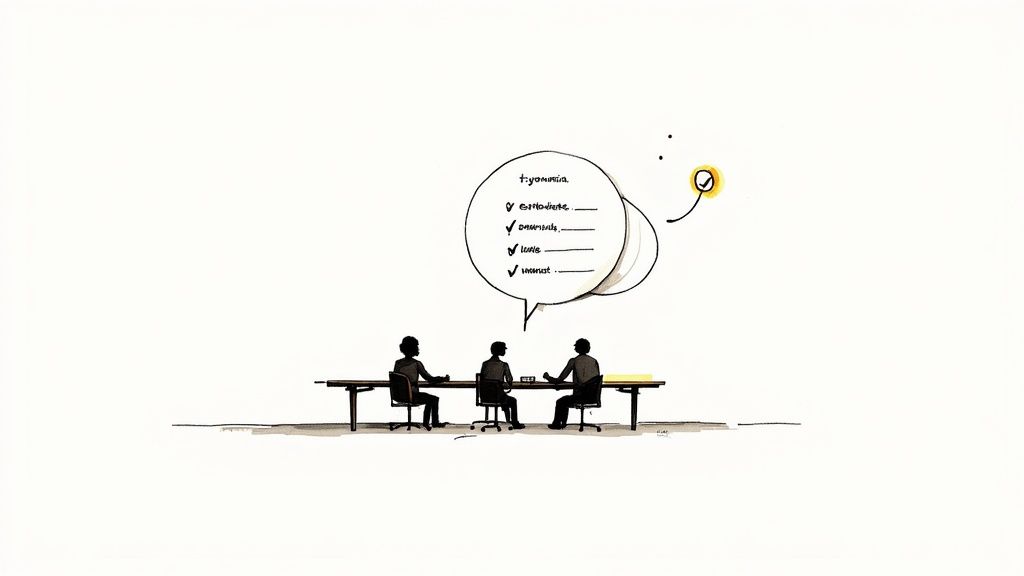
As the image shows, these tools are built to make collaboration smoother by ensuring meeting content is always accessible and easy to verify.
The Growing Demand for Accurate Records
The shift toward documenting conversations isn't a niche trend; it's a significant market movement. The global transcription industry was valued at around $21 billion in 2022 and is projected to exceed $35 billion by 2032. This growth is fueled by massive advancements in AI and the ever-present need for better documentation in a business world that is increasingly global and remote. For more on AI meeting transcription trends, Superagi.com offers some excellent insights.
How AI Transcription Actually Works
So, how does automated meeting transcription work its magic? Forget the complex technical jargon. The simplest way to understand it is to imagine a lightning-fast stenographer who listens to every word in your meeting and types it out in real-time. That's the core idea, but the technology powering it is where things get truly impressive.
The heart of the process is a technology called Automatic Speech Recognition (ASR). This is the "hearing" component. ASR software analyzes the sound waves from your audio or video file—all the peaks and valleys of human speech—and converts them into raw text. If you want to dive deeper, we explain it all in our guide on what is ASR. However, simply turning sounds into a string of words isn't enough to create a useful transcript.
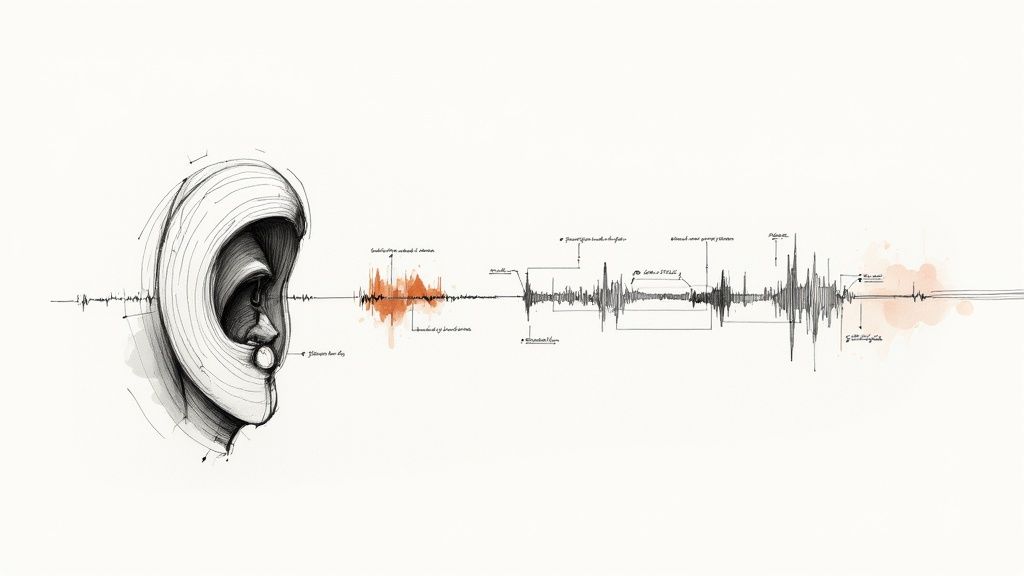
This is where another layer of intelligence comes into play. To truly make sense of the conversation, advanced Natural Language Processing (NLP) tools are used to give the transcript structure and coherence. NLP is the "understanding" part of the process.
NLP is what allows the AI to add punctuation, organize text into logical paragraphs, and even identify who is speaking. It's the key to transforming a chaotic stream of words into a clean, readable document.
The Big Shift From Manual To Automated
This technological leap represents a massive departure from traditional methods. In the past, transcribing a meeting meant hiring a human transcriptionist. The process was slow, costly, and could take days—or even weeks—to get a file back.
AI-powered services like MeowTxt have completely revolutionized the industry. Instead of waiting for days, you receive a highly accurate transcript in just minutes. This incredible speed and scalability make meeting transcription a practical tool for everyone, from solo entrepreneurs to large enterprise teams.
The market has responded enthusiastically. The global AI transcription market is forecast to grow from $4.5 billion in 2024 to approximately $19.2 billion by 2034. This isn't just a fleeting trend; it’s a clear indicator that businesses are moving away from slow, manual methods toward instant, automated solutions. This is about more than saving time—it's about finally unlocking the value hidden in countless conversations that used to vanish the moment a meeting ended.
Unlocking Real-World Business Benefits
A meeting transcript is far more than a written record. It’s a versatile business asset that delivers tangible, measurable value across your entire organization. When you convert spoken conversations into searchable, shareable text, you’re not just documenting what was said—you’re creating new opportunities for growth, efficiency, and smarter collaboration.
Consider a product development team. For them, transcripts of user feedback calls are an absolute goldmine. They can instantly search for keywords like "frustrating" or "wish it could" to pinpoint exact customer pain points and feature requests. This isn't guesswork; it's data-driven product development guided by direct evidence from the people who matter most.
Driving Departmental Success
The impact of meeting transcription extends well beyond product teams. Every department can leverage transcripts to turn their everyday meetings into strategic assets.
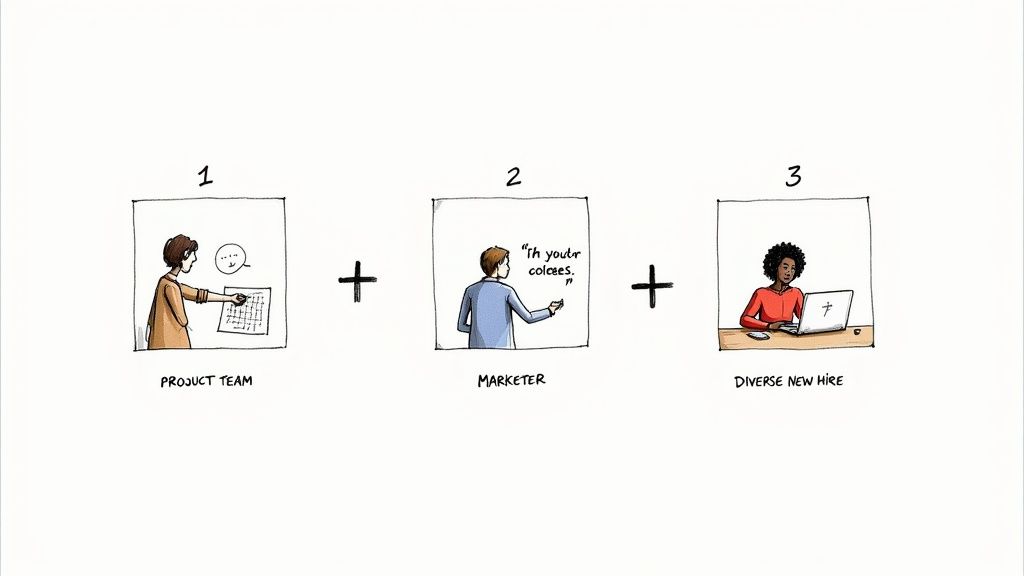
- Marketing Teams: Imagine scanning client interviews and webinar transcripts for powerful testimonials and customer quotes. They can also identify the exact language and keywords customers use, which is invaluable for crafting SEO content and ad copy that truly resonates.
- Sales Teams: Successful salespeople know that follow-up is everything. By reviewing transcripts from discovery calls, they can capture every client need, question, or objection that might have been missed in the moment, leading to more precise and persuasive proposals.
- Human Resources: How can you get new hires up to speed faster? Provide them with a library of key strategic meetings to review. This offers crucial context on company culture, project history, and decision-making that they can absorb at their own pace.
The core value is turning spoken dialogue into structured data. A single transcribed meeting can serve as a research document, a training module, a legal record, and a source for marketing content all at once.
This wide-ranging utility is why the market is expanding so rapidly. By 2025, the U.S. transcription services market surpassed $32 billion, with specialized niches like legal transcription alone accounting for $2.62 billion. These figures underscore how critical accurate documentation has become across all industries. You can find more data on the general transcription services market on dittotranscripts.com.
The table below highlights a few more practical ways different teams can put meeting transcripts to work.
Meeting Transcription Use Cases by Department
| Department | Primary Use Case | Business Impact |
|---|---|---|
| Product | Analyze customer feedback calls | Faster, data-driven product improvements |
| Marketing | Extract testimonials and keywords | More effective ad copy and SEO content |
| Sales | Review discovery calls for objections | Higher proposal win rates |
| HR | Onboard new hires with meeting archives | Reduced ramp-up time for new employees |
| Engineering | Document technical spec meetings | Fewer misunderstandings and errors in development |
| Customer Support | Identify recurring user issues | Proactive improvements to user experience |
As you can see, the applications are incredibly broad, turning what was once a passive record into an active tool for continuous improvement.
Fostering an Inclusive Workplace
Beyond improving the bottom line, meeting transcription is also a powerful tool for building a more inclusive and accessible workplace. It serves as an essential resource for team members who are deaf or hard of hearing, ensuring they have full, equal access to every conversation.
It also benefits non-native English speakers who may want to review a discussion to clarify complex topics or unfamiliar terms. By providing a clear written record, you empower every person on your team to participate and contribute to their fullest potential, regardless of their circumstances.
Tips for Nailing Maximum Accuracy
The ultimate goal of meeting transcription is to obtain a useful, reliable record. While today's AI is remarkably advanced, its accuracy isn't magic—it directly reflects the quality of the audio you provide. The good news is that you have significant control over the final outcome.
Think of it like taking a photograph. A crisp, clear shot results in a great picture, while a blurry, shaky one produces a mess. If you give the AI a clean audio file, it will deliver a near-perfect transcript. This process begins long before you hit the "transcribe" button.
Optimizing Your Recording Environment
There's an old principle in programming: garbage in, garbage out. This holds just as true for transcription. High-quality audio is the single most important factor in achieving an accurate transcript. Before starting your next meeting, run through this quick checklist.
- Use a Decent Mic: Your laptop's built-in microphone simply isn't good enough. A dedicated external USB mic or even a quality headset will drastically reduce echo and background noise, capturing voices with much greater clarity.
- Pick a Quiet Spot: Find a room with minimal ambient noise. The hum of an air conditioner, nearby conversations, or sirens can easily confuse the AI and jumble your text.
- Set Clear Speaking Rules: Encourage participants to speak one at a time and avoid talking over each other. This is crucial. Overlapping conversations are one of the most difficult challenges for any transcription software to solve.
These small adjustments can boost your accuracy from good to great, saving you time and effort on edits later.
The Human Touch After the Fact
Even with a flawless recording, AI isn't infallible. It can struggle with unique names, company-specific acronyms, or industry jargon that isn't part of its standard vocabulary. That’s why a quick human review is the final, essential step to ensure your transcript is 100% reliable.
A few minutes of proofreading can catch the subtle mistakes an AI might miss, correcting ambiguous phrases and ensuring every proper noun is spelled correctly. This is what transforms a good transcript into a flawless one.
This final check isn't about rewriting the entire document; it's about fine-tuning. Simply scan for the names of people, products, or technical terms the AI might have misunderstood. For a deeper dive into making your edits count, check out our guide on the importance of proofreading in transcription.
Combine great audio with a quick final review, and you’ll get an accurate, trustworthy meeting transcript every single time.
Choosing the Right Transcription Service
With so many transcription tools available, selecting the right one can feel overwhelming. The key is to ignore the marketing hype and focus on what truly matters for your workflow and budget.
First, consider how you'll be using the service. Are you transcribing a one-off project, or do you need to transcribe team meetings every day?
Your answer will guide you to the appropriate pricing model. A pay-as-you-go service like MeowTxt is ideal for individuals or teams with fluctuating needs. You only pay for the minutes you actually use, which is far better than being locked into a subscription that goes unused. Conversely, if your team consistently transcribes a high volume of audio, a monthly plan could offer better value in the long run.
Evaluating Key Features
Beyond the price tag, a service's features are what determine whether it becomes a valuable asset or a frustrating bottleneck. Look for tools that simplify your job, not complicate it.
- Speaker Identification: Does the service automatically detect and label different speakers? For any meeting with more than one person, this is non-negotiable. It makes the transcript readable and easy to follow.
- Multi-Language Support: If you work with a global team or international clients, you'll need a tool that can handle meetings in various languages—and perhaps even translate them.
- Essential Integrations: A great service should integrate seamlessly with the tools you already use. Look for connections to platforms like Zoom, Google Meet, or Microsoft Teams to automate your transcription workflow.
A major decision point is choosing between a pure AI service and one that offers a human review option. The quality of your audio is the best guide here.
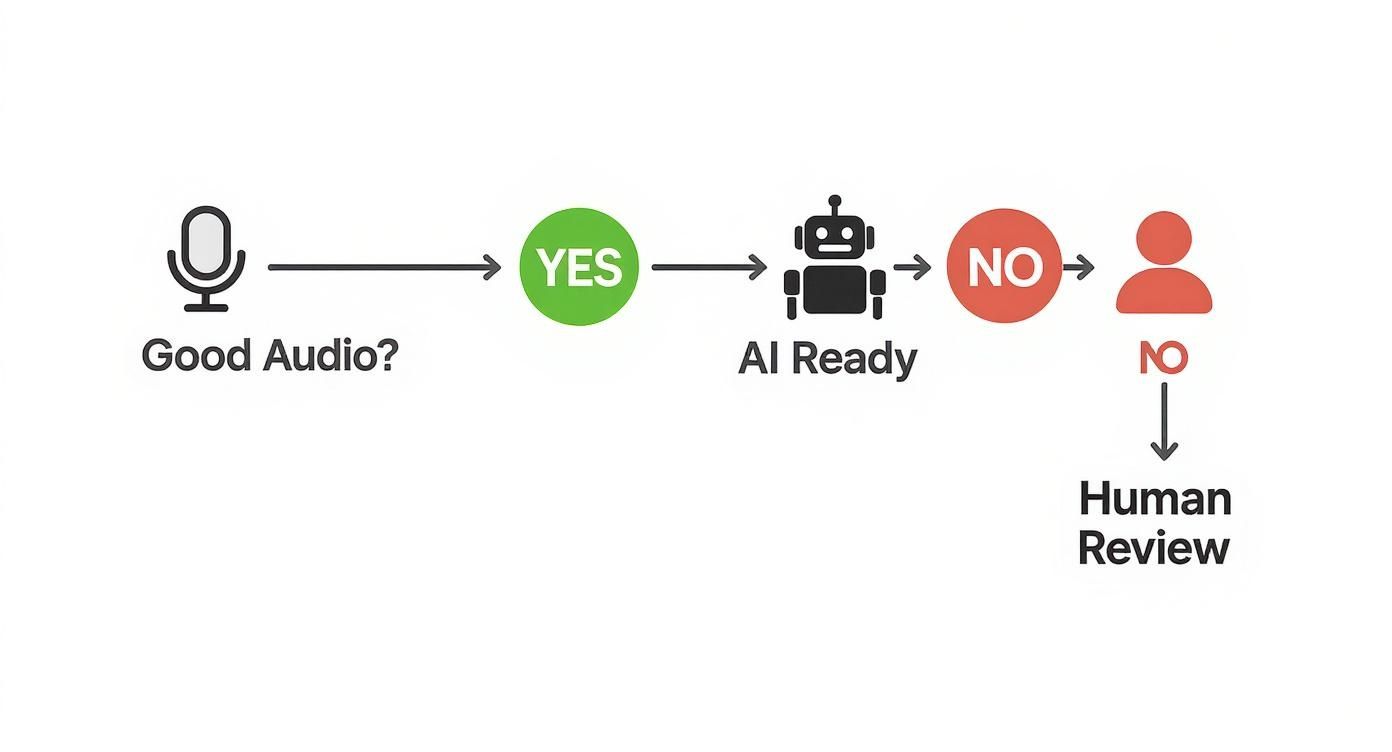
As you can see, clean, high-quality audio is a perfect match for AI. However, if your recording has significant background noise or people talking over each other, a human touch can make a world of difference.
To help you decide, here's a quick breakdown of how these two approaches compare.
Comparing Transcription Service Models
| Feature | Automated AI Service | Human Transcription Service |
|---|---|---|
| Speed | Extremely fast (minutes) | Slower (hours to days) |
| Cost | Very low (pennies per minute) | Higher (dollars per minute) |
| Accuracy | Up to 97.5% with clear audio | Up to 99% or higher |
| Best For | Internal notes, quick summaries, searchable archives | Public content, legal records, poor audio quality |
| Scalability | Nearly infinite; handles huge volumes easily | Limited by human workforce |
| Consistency | Highly consistent output | Can vary slightly between transcriptionists |
Ultimately, the choice comes down to a classic trade-off: speed and cost versus absolute precision.
AI Speed vs. Human Polish
Automated AI services are incredibly fast. They can convert an hour-long meeting into a full transcript in just a few minutes, and they do it for a fraction of the cost of a human service. This makes them the ideal choice for most internal business needs, such as creating meeting notes, tracking action items, and building searchable archives of discussions.
Services that include a "human-in-the-loop," however, add a layer of quality control that AI cannot yet match. They are the right choice when you need near-100% accuracy for materials like legal depositions, published interviews, or any content intended for a public audience. That final polish costs more and takes longer.
For the vast majority of day-to-day meetings, the speed, affordability, and surprisingly high accuracy of a modern AI tool are more than sufficient to get the job done right.
Navigating Security and Compliance Concerns
Handing over recordings of your private conversations requires an immense amount of trust. Consider the sensitive information contained in those recordings—from confidential product roadmaps to next quarter's financial forecasts. Security isn't just a feature on a list; it's the absolute foundation of a trustworthy transcription service.
Before uploading any file, you must be confident that the provider takes your data's safety as seriously as you do. The first thing to look for is end-to-end encryption. This is like placing your meeting audio inside a locked, armored vault. Only you and the transcription service have the keys, ensuring the data is completely unreadable to anyone else while it's in transit and at rest on their servers.
Understanding Your Data Rights
Beyond encryption, you need to know exactly where your data is going and who controls it. Reputable services are transparent about their data policies and adhere to major privacy regulations.
- GDPR Compliance: If you conduct business in Europe, your provider must comply with the General Data Protection Regulation. This gives you control over how your personal data is handled and stored.
- Data Residency: Some services allow you to choose the geographic region where your data is stored. This is a critical feature for meeting specific industry or national data laws.
- HIPAA Compliance: For anyone in the healthcare sector dealing with patient information, a service must adhere to the Health Insurance Portability and Accountability Act (HIPAA) to keep that data private and secure.
When you use a third-party service, you're essentially outsourcing a piece of your data management. It's your responsibility to vet their security posture to avoid putting your company at risk.
This vetting process is a crucial part of your own due diligence. When you engage an outside service for meeting transcription, having a solid grasp of third-party risk management is vital to ensure your information remains safe and compliant. Asking the tough questions before you sign up is what protects your most confidential data and helps you make a secure, informed decision.
Got Questions? We’ve Got Answers.
Even after seeing how it all works, you might still have a few questions. Let's tackle the most common ones so you can move forward with total confidence.
Just How Accurate Is This AI Stuff?
Modern AI transcription can achieve 95% accuracy or even higher, but there's a key condition: it requires clean audio. This means minimal background noise and clear, distinct speakers.
Of course, factors like heavy accents, people talking over each other, or highly specialized industry jargon can sometimes trip up the AI. That's why any good service includes a simple, user-friendly editor. A quick five-minute review is usually all it takes to correct any minor errors and bring your transcript to 100% accuracy.
Can AI Tell Who Is Speaking?
Absolutely. This is a critical feature known as speaker diarization (or speaker identification). The AI is intelligent enough to detect when the voice changes and will automatically label the dialogue (e.g., Speaker 1, Speaker 2).
The best part? Tools like MeowTxt allow you to easily go in and replace those generic labels with actual names. This simple step makes the final transcript infinitely easier to follow, allowing you to see exactly who said what at a glance.
Is It Safe to Upload Confidential Meetings?
Reputable transcription services take security extremely seriously. Before uploading anything, look for commitments to end-to-end encryption, which scrambles your data during upload and while it's stored on their servers.
You should also verify that the provider complies with major privacy laws like GDPR and has a transparent, easy-to-understand data policy. Taking a moment to confirm these security credentials is a non-negotiable step before entrusting a service with sensitive company information.
Ready to turn your conversations into searchable, actionable assets? Try MeowTxt today and get your first 15 minutes of transcription free. Experience the speed and accuracy of AI with a simple, pay-as-you-go model. Start transcribing for free at meowtxt.com.


